
College Connect
Preparing your experience...
Preparing your experience...

Need help? 👋
We're here to help you
Looking for the right college, course or admission guidance? Choose an option below.
Learn how to prepare for a college career fair, research participating employers, create a professional introduction, ask recruiters relevant questions, present your skills, evaluate opportunities and follow up after the event.
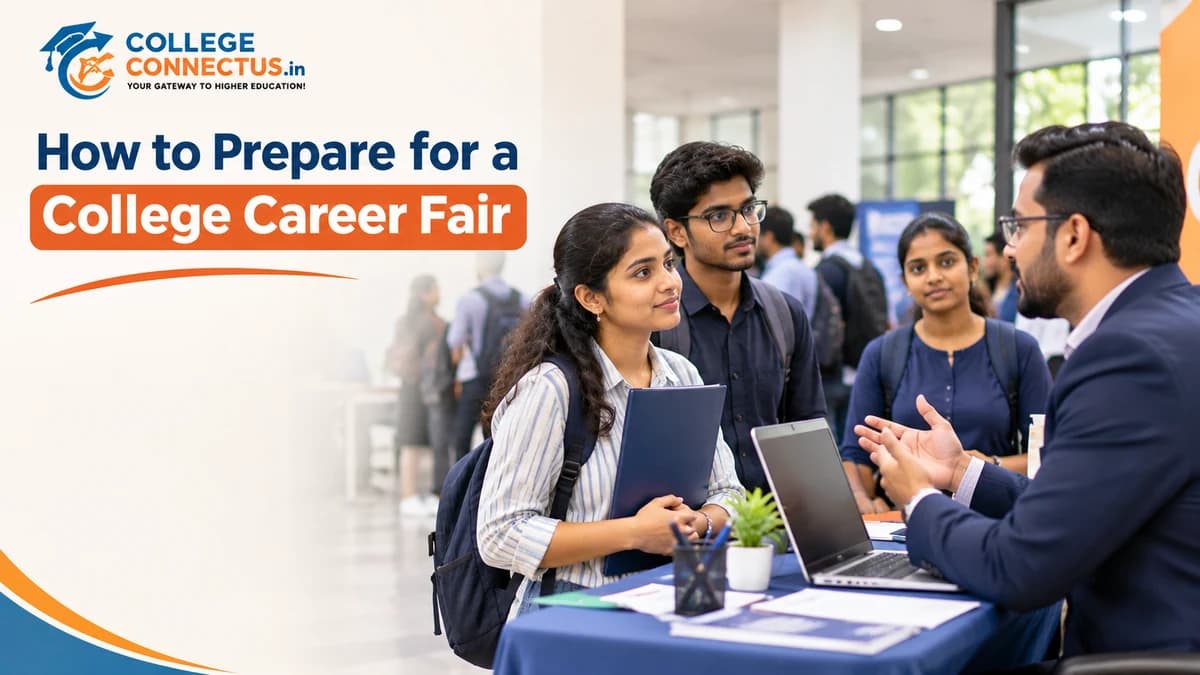
A college career fair can help students discover job opportunities, learn about different industries, meet recruiters and understand the skills employers are looking for. However, attending an event without preparation can make it difficult to identify the right employers, explain your strengths or decide what to do next.
Whether you are a first-year student exploring career options, a final-year student preparing to graduate or a fresher looking for an entry-level role, a career fair can be a valuable learning experience.
The key is to approach the event with a clear plan. You do not need years of professional experience to make a positive impression. You need to understand your interests, communicate honestly, ask thoughtful questions and follow up appropriately.
This guide explains how to prepare for a college career fair in India, interact with recruiters, evaluate opportunities and turn conversations into useful next steps.
A college career fair is an event where employers, organisations or industry representatives interact with students and graduates to discuss career opportunities.
Depending on the institution and event, participating organisations may include:
Private companies and established businesses
Startups and growing organisations
Technology and engineering companies
Banks and financial services organisations
Consulting and professional services firms
Manufacturing and infrastructure companies
Media, marketing and creative agencies
Non-profit organisations
Companies offering internships, graduate programmes or entry-level jobs
Some career fairs focus on a particular industry, while others welcome employers from multiple sectors. They may be organised by a college placement cell, career development office, student association or external event organiser.
A career fair is not necessarily a recruitment drive. Some organisations may conduct interviews or collect applications, while others may focus on employer awareness, networking or sharing information about future opportunities.
Before attending, check the event announcement to understand its purpose, participating employers, eligibility requirements and registration process.
Start by identifying your main reason for attending the career fair.
Without a clear objective, you may spend time visiting booths without learning anything useful.
Your objective could be to:
Explore career options related to your degree.
Find internships or graduate-level opportunities.
Understand the skills required for a particular role.
Learn about industries you have not considered before.
Ask employers about their recruitment processes.
Build professional connections.
Practise introducing yourself to industry representatives.
Your objective may change depending on your academic year.
For example, a first-year student might want to understand different career paths, while a final-year student may prioritise organisations offering entry-level positions.
Write down two or three goals before the event. These will help you decide which employers to approach and which questions to ask.
One of the most useful ways to prepare for a career fair is to research employers before meeting their representatives.
Most events provide a list of participating organisations. Review it carefully and identify the companies that match your interests, academic background and career goals.
For each priority organisation, find out:
What does the company do?
Understand its main products, services, customers or areas of work. You do not need to memorise the company's entire history. A basic understanding is enough to start a meaningful conversation.
Which roles might suit your background?
A B.Tech student may be interested in technical, engineering or operations roles. A B.Com student may explore finance, accounting, banking or business operations. A BCA student may investigate software development, IT support, testing or other technology-related opportunities.
These are starting points rather than fixed career paths. Actual eligibility depends on the role and employer.
What skills does the company value?
Look at job descriptions, internship announcements and graduate recruitment information. Note recurring technical skills, communication requirements, tools, qualifications and experience expectations.
Does the company have current openings?
If the organisation publishes vacancies, check the requirements and application procedure. Some employers may direct candidates to apply online rather than accept applications at the event.
Use official company career pages or verified recruitment announcements when checking vacancies. Do not assume that every company attending a career fair is recruiting for every position.
Create a shortlist of around five to eight priority organisations, depending on the size of the event.
You can also use College Connect Us to strengthen your broader college and career research. For example, the guide on how to evaluate college placements in India explains why placement information should be assessed carefully rather than judged by a single headline figure.
You may have only a few minutes to speak with a recruiter. A short, natural introduction helps you explain who you are and why you approached the organisation.
Your introduction should cover four points:
Your name and academic background.
Your area of interest.
A relevant project, skill or experience.
The opportunity or information you are seeking.
For example:
"Hello, I'm a final-year BCA student interested in software development. I have been working on a web development project using JavaScript and a database. I wanted to learn more about entry-level technology roles at your organisation and the skills you expect from fresh graduates."
A student studying mechanical engineering might say:
"Hello, I'm a third-year mechanical engineering student interested in manufacturing and production systems. I've completed an academic project related to machine design, and I'd like to understand what skills your company looks for in engineering interns."
These introductions are starting points, not scripts that everyone must copy. Adapt the wording to your own background.
Keep your introduction brief, honest and relevant. Avoid listing every subject you have studied or making claims about skills you cannot demonstrate.
Practise speaking aloud before the event. The goal is not to sound rehearsed; it is to become comfortable explaining your interests.
Before printing or sharing your resume, review it for accuracy and readability.
Your resume should make it easy for a recruiter to understand your educational background, relevant skills, projects, experience and achievements.
Check the following:
Your contact information is correct.
Your education details are accurate.
Your technical and professional skills reflect your actual abilities.
Your projects include a brief explanation of what you did.
Your spelling and formatting are consistent.
Your links to portfolios or professional profiles work.
Your resume does not contain unnecessary personal information.
If you are still developing your resume, read the College Connect Us guide on building a professional resume as a college student in India.
Prepare a few copies if the event is in person and employers have indicated that printed resumes are useful. Keep a digital copy available on your phone or another accessible device.
You may also prepare a simple portfolio link if your field benefits from examples of practical work. Students in software development, design, writing, marketing and other project-based fields may find it useful to show selected work.
For more guidance, see how to build a strong college portfolio in India.
Do not send your resume indiscriminately to every organisation. Share it when relevant, and follow the employer's stated application procedure.
Your clothing should be clean, comfortable and appropriate for a professional event.
A formal or smart-casual outfit is usually a reasonable choice, but check whether the college or organiser has provided a dress code.
You do not need expensive clothing or accessories to attend a career fair. Focus on neatness, comfort and being prepared to interact professionally.
For an in-person event, consider carrying:
Your student ID, if required.
A few copies of your resume.
A notebook or a notes app on your phone.
A pen.
Your phone with sufficient battery.
A list of priority companies and questions.
Any event registration confirmation or entry pass.
If the event is online, check your internet connection, microphone, camera and meeting instructions beforehand. Keep your resume and notes readily available.
For both formats, make sure you understand the event schedule and know how to access the sessions or employer booths.
A little planning can help you use your time effectively.
Review the event layout or online exhibitor directory, if available. Identify the locations or virtual sessions of your priority employers.
If you are attending in person, consider starting with a company that interests you but is not your highest priority. This gives you an opportunity to practise your introduction before approaching your most important employers.
However, do not deliberately interrupt a recruiter or occupy their time when a queue is forming. Follow the event's instructions and respect other students waiting to speak.
During the event:
Prioritise organisations that match your interests.
Leave time for unexpected discoveries.
Attend relevant talks or demonstrations.
Record useful information after each conversation.
Keep track of application deadlines mentioned by employers.
Avoid spending the entire event at one booth unless there is a specific reason, such as a scheduled interview or detailed discussion.
Your goal is to have useful conversations, not simply to collect the largest number of brochures or business cards.
Good questions help you understand an organisation and demonstrate that you have prepared.
Instead of asking only, "Are you hiring?", use questions that encourage a useful conversation.
What types of roles are available for recent graduates?
Which academic backgrounds are relevant to these roles?
Does your organisation offer internships or graduate training programmes?
Where can students find verified details about current openings?
Which technical or professional skills are most important for this role?
What practical experience helps students prepare for entry-level positions?
Are there particular tools, technologies or industry practices students should learn?
How does your organisation evaluate candidates who have limited professional experience?
What are the usual stages of your recruitment process?
Are there any eligibility requirements students should check before applying?
Should interested candidates apply online after this event?
Is there an application deadline or an official recruitment page we should follow?
What might a typical day look like for someone in this position?
What training or mentoring is available to new employees?
Which teams would a graduate typically work with?
What distinguishes a strong candidate during the selection process?
You do not need to ask every question. Choose two or three that fit the conversation.
Avoid asking for information that is clearly available in the employer's published material. Also, do not assume the representative can disclose confidential salary information, guarantee selection or make exceptions to eligibility rules.
You do not need to know everything about an industry to have a useful conversation.
If a recruiter asks about a skill you have not learned, answer honestly. You can explain what you know, what you have tried and what you plan to learn next.
For example:
"I haven't worked with that tool yet, but I understand the underlying concept and would be interested in learning how it is used in your team's projects."
If you do not understand a question, politely ask the recruiter to clarify it.
Listen carefully rather than planning your next sentence while the other person is speaking. Allow the recruiter to finish, respond to what they have said and ask relevant follow-up questions.
Your communication should be respectful and clear. Avoid exaggerating project contributions, claiming certifications you do not have or presenting a team achievement as entirely your own work.
If you want to strengthen your professional communication, read how to improve communication skills for college students and freshers in India.
Remember that a career fair is also a learning opportunity. A conversation that does not result in an immediate job application can still help you understand an industry or identify skills to develop.
After speaking with an employer, write down a few useful details while they are still fresh in your mind.
Record:
The organisation's name.
The recruiter's name or role, if voluntarily provided.
The positions or programmes discussed.
Relevant eligibility requirements.
Application instructions and deadlines.
Skills the recruiter recommended developing.
Any agreed next step.
If the representative directs you to an official website, record the page or application route accurately.
These notes will help you compare opportunities and avoid confusing information from different employers.
If you receive contact details, use them only for the purpose for which they were shared. Do not add someone to mailing lists or share their contact information without permission.
A company name alone does not tell you whether a role is suitable.
After the career fair, review the opportunities you discovered against your priorities.
Consider the following factors.
Role responsibilities: Do the tasks match your interests, skills and longer-term goals?
Eligibility: Do you meet the published requirements for education, graduation year, location or other conditions?
Learning opportunities: Is there training, mentoring or scope to develop useful skills?
Employment terms: If an offer is made, are the salary, work location, working hours, employment type and other terms clearly explained?
Career relevance: Will the role help you build relevant experience or explore an area you genuinely want to understand?
Practical considerations: Can you manage the location, commuting arrangements, relocation requirements or other commitments?
Do not accept an opportunity solely because a recruiter was friendly or the organisation is well known. Read the job description and any offer documents carefully.
Be cautious if someone requests money for a guaranteed job, demands unnecessary sensitive information or pressures you to accept an offer immediately. Verify the organisation and recruitment process through reliable channels before proceeding.
If a company invites you to an interview, prepare separately for that stage. The College Connect Us guide on preparing for campus placements in India can help you understand aptitude tests, interviews and group discussions.
Your work does not end when the event finishes.
Review your notes, identify the most relevant opportunities and complete any agreed next steps.
If a recruiter asks you to apply online, follow the instructions and submit the required information before the stated deadline. If they invite you to send your resume, ensure that the file is correct and use a clear filename.
If you have permission to contact a recruiter, a short thank-you message can help you maintain a professional connection.
For example:
"Hello, thank you for speaking with me at the college career fair today. I appreciated learning about the entry-level opportunities at your organisation and the skills your team values. I will review the application information you shared and follow the stated process. Thank you for your time."
Personalise your message by mentioning something specific from the conversation. Keep it brief and professional.
Do not send repeated messages if you do not receive an immediate reply. Follow the employer's stated communication process and allow a reasonable amount of time for a response.
If you connect with a recruiter on a professional networking platform, make your request relevant and respectful. Do not assume that accepting a connection means you will receive a referral or job offer.
A career fair can reveal gaps between your current skills and the requirements of the roles you want.
Use your notes to create a simple action plan.
What you learned | Possible next step |
|---|---|
Employers frequently ask for a particular technical skill | Identify a suitable learning resource and practise through a small project |
Recruiters recommend practical experience | Develop a project that demonstrates relevant skills |
You need a stronger resume | Update your resume with accurate skills, projects and achievements |
A role requires a specific qualification | Verify the requirement and assess whether the role is suitable |
You discovered an unfamiliar career path | Research typical responsibilities, required skills and entry routes |
An employer has an active vacancy | Check the official job description and apply if eligible |
Your introduction was difficult to deliver | Practise a concise introduction and ask for feedback |
Set realistic deadlines for each action. You do not need to learn every skill mentioned at the event. Prioritise those that repeatedly appear in relevant job descriptions and align with your goals.
You can also review your existing academic projects and identify ways to explain the problem, your contribution, the tools used and the outcome more clearly.
Small, consistent improvements are more useful than collecting advice without acting on it.
Students can make the event less useful by approaching it without preparation. Watch out for these common mistakes.
Attending without researching employers: You may miss relevant opportunities or ask questions that could have been answered beforehand.
Using the same introduction for every company: Tailor your opening to the employer and the type of role you want to explore.
Focusing only on famous companies: A less familiar organisation may offer relevant work, practical learning or opportunities that better match your interests.
Exaggerating your skills: Honest explanations help recruiters understand your actual strengths and development needs.
Asking only about salary: Compensation is an important consideration when evaluating an offer, but a first conversation may be more useful if you also explore role responsibilities, eligibility and recruitment steps.
Collecting contacts without building context: A useful conversation and clear next step are more valuable than a long list of names.
Ignoring application instructions: If an employer directs you to an official application portal, follow that process rather than assuming a conversation at the event counts as an application.
Failing to follow up: Relevant vacancies, application deadlines and promised next steps can be missed if you do not review your notes.
Trusting every recruitment claim: Verify job details and company identity, especially if someone asks for payment or makes unrealistic promises.
Use this checklist before, during and after the event.
Register and confirm the event details.
Review the list of participating organisations.
Research your priority employers.
Identify suitable roles, internships or graduate programmes.
Update and proofread your resume.
Prepare a short professional introduction.
Select two or three questions for each priority employer.
Check the dress code, location and schedule.
Prepare printed or digital copies of relevant documents.
Approach employers respectfully.
Introduce yourself clearly.
Ask relevant questions and listen carefully.
Take notes on requirements and next steps.
Follow the event's instructions.
Share your resume only when appropriate.
Thank representatives for their time.
Review your notes.
Verify vacancies and application instructions.
Apply to relevant opportunities before their deadlines.
Send appropriate follow-up messages where permitted.
Identify skills you need to develop.
Create a realistic action plan.
Track applications and any responses.
Preparing for a college career fair in India is about more than dressing professionally or carrying multiple copies of your resume. It involves researching employers, understanding your interests, communicating your skills honestly and identifying meaningful next steps.
You do not need to leave the event with a job offer for it to be worthwhile. Learning what employers expect, discovering unfamiliar career paths and identifying skills to develop can all help you make better career decisions.
Start with a few clear goals, prepare thoughtfully and follow up on the opportunities that genuinely match your interests. Over time, these habits can make networking and career exploration more productive.
Explore more student resources on College Connect Us to research colleges, understand placement information and prepare for the transition from education to employment.
Explore expert articles, admission guides, career tips, education news, exam preparation, and everything you need to make informed academic decisions.