
College Connect
Preparing your experience...
Preparing your experience...

Need help? 👋
We're here to help you
Looking for the right college, course or admission guidance? Choose an option below.
Learn how to prepare for campus placements in India with a structured plan for aptitude tests, resume building, technical skills, group discussions and HR interviews. Discover how to research employers, practise mock interviews, track applications, avoid common mistakes and balance placement preparation with academic
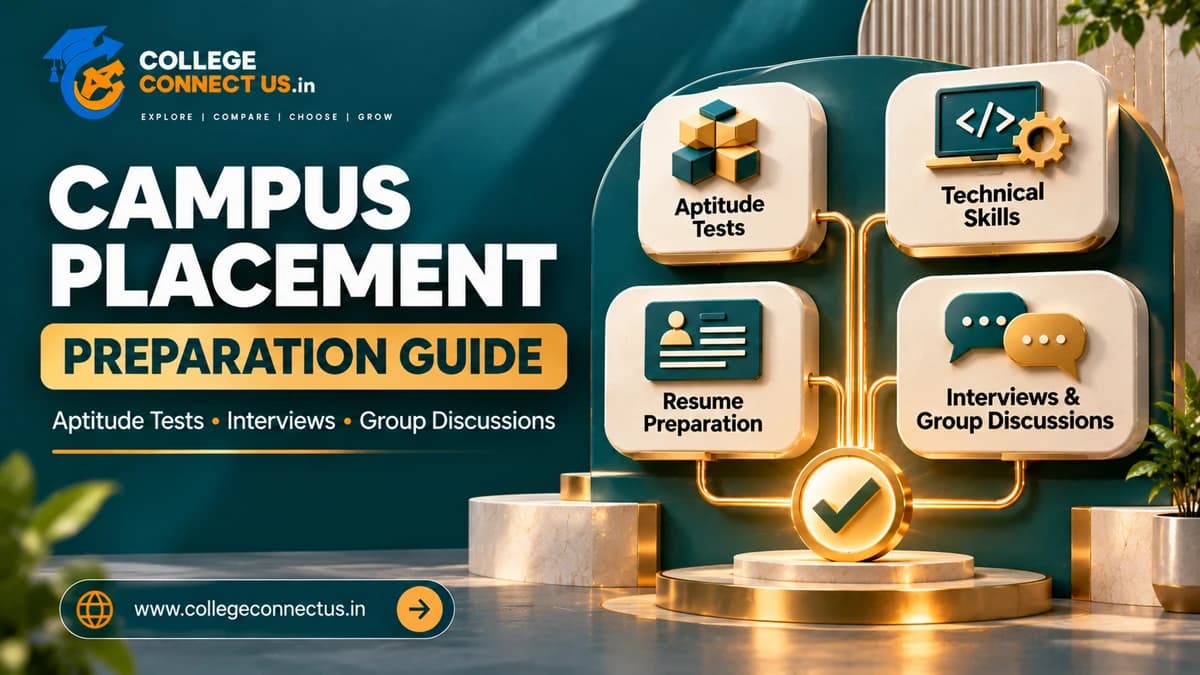
Campus placements can be an important step between college and your first full-time job. For many students in India, the placement season brings opportunities to connect with employers, demonstrate their skills and begin building professional experience.
However, getting ready for campus placements involves more than preparing a resume a few days before an interview. Students may need to practise aptitude questions, strengthen technical knowledge, improve communication, research employers and prepare clear answers about their education and projects.
The selection process also varies. Some employers use online assessments and technical interviews, while others include group discussions, coding rounds, case studies, presentations or multiple interview stages. Not every company uses every stage, so students should understand the requirements of their target roles.
This guide explains how to prepare for campus placements in India, organise your preparation, avoid common mistakes and approach the selection process with greater confidence.
Campus placements are recruitment activities organised by employers in collaboration with a college or university. Participating organisations may invite eligible students to apply for internships, graduate trainee positions or full-time entry-level jobs.
A college placement cell may coordinate employer visits, circulate job descriptions, communicate eligibility criteria and schedule recruitment activities. The precise process depends on the institution and the employer.
Campus placements may be available for students from engineering, management, commerce, science, arts and other academic backgrounds. The opportunities, eligibility requirements and selection methods differ by course, employer and role.
Before preparing, understand the placement opportunities available through your institution and identify the roles that match your skills and career interests.
The first step is to understand how recruitment works at your college.
A typical campus recruitment process may include the following stages:
Company announcement: The placement cell shares information about an employer and its vacancies.
Eligibility screening: Students are checked against requirements such as degree, graduation year, academic marks, backlogs or other stated conditions.
Application and registration: Eligible students submit their details and required documents.
Assessment round: Candidates may take an aptitude test, coding assessment, technical test, written exercise or other evaluation.
Group discussion or task: Some employers assess communication, teamwork, reasoning or problem-solving through a group activity.
Interview rounds: Shortlisted candidates may attend technical, functional, managerial or HR interviews.
Selection decision: The employer communicates the result and, where applicable, shares an offer and its conditions.
This is an illustrative sequence, not a universal process. Employers can combine, reorder or omit stages.
Try to find out:
Which employers are expected to recruit students from your course?
What roles are available?
What eligibility conditions apply to each role?
Are there restrictions relating to academic backlogs or previous offers?
Which documents must be submitted?
What are the registration deadlines?
Are students expected to follow any placement-cell rules?
Where will official announcements and schedules be published?
Keep a record of deadlines and instructions. Missing a registration window or misunderstanding an eligibility condition can prevent you from participating, regardless of your preparation.
Do not prepare for every possible job at the same time. Start by identifying a few realistic role categories that match your education, interests and current skills.
For example:
Academic background | Possible entry-level roles | Areas to prepare |
|---|---|---|
Engineering and computer science | Software developer, graduate engineer trainee, QA tester | Programming fundamentals, problem-solving, projects and technical concepts |
Electronics and related engineering | Graduate engineer trainee, testing or support roles | Core subjects, troubleshooting, quantitative aptitude and role-specific concepts |
Management | Management trainee, sales, operations or business development roles | Communication, business fundamentals, analytical reasoning and case-based questions |
Commerce and finance | Accounts assistant, finance operations or analyst trainee | Accounting fundamentals, spreadsheets, numerical reasoning and role-specific knowledge |
Arts and humanities | Content associate, research assistant, customer success or communication roles | Writing, research, communication, critical thinking and relevant portfolio work |
Science | Research assistant, laboratory trainee or data-related entry-level roles | Subject fundamentals, practical skills, data handling and role-specific knowledge |
These are examples, not guaranteed opportunities. Actual eligibility depends on the employer and job description.
A job description can help you understand what the employer expects. Look for:
Required degree or specialisation
Graduation year
Minimum academic performance, if specified
Technical or professional skills
Communication requirements
Location and work arrangement
Training period and employment terms
Selection stages
Any bond, service agreement or other contractual conditions
Do not apply based on the job title alone. Understand the responsibilities and conditions before deciding whether the opportunity suits you.
Aptitude assessments are used by some employers to evaluate numerical ability, logical reasoning, verbal skills and problem-solving. The exact subjects and difficulty level vary by company and role.
Depending on the test, useful topics may include:
Percentages and ratios
Averages
Profit and loss
Time and work
Speed, distance and time
Number systems
Basic algebra
Probability and permutations
Data interpretation
Start with concepts and worked examples before attempting timed practice. If you repeatedly make mistakes in one topic, revise that topic instead of simply completing more questions.
Preparation may include:
Number and letter series
Pattern recognition
Arrangements
Coding and decoding
Syllogisms
Directions
Basic analytical reasoning
Data-based reasoning
Read each question carefully. Some errors happen because students rush through instructions rather than because they lack the required knowledge.
Depending on the employer, you may need to practise:
Reading comprehension
Sentence correction
Grammar fundamentals
Vocabulary in context
Sentence ordering
Written communication
Regular reading and short writing exercises can help you improve comprehension and clarity over time.
Use a simple cycle:
Learn the concept.
Solve untimed questions.
Review incorrect answers.
Practise a short timed set.
Record recurring mistakes.
Repeat the topics that need improvement.
Keep an error log that records the question type, the reason for the mistake and the correct approach. Review it weekly.
Important: Do not focus only on speed. Accuracy, question selection and time management all matter. In a timed test, it may be more effective to solve questions you understand first and return to difficult questions if time remains, provided the test rules allow this.
Technical preparation depends on the role you are applying for. Students should focus on fundamentals and practical understanding rather than trying to learn every technology or topic at once.
Consider revising:
Programming fundamentals in a language you know
Data structures and algorithms, where relevant
Object-oriented programming concepts
Databases and SQL
Operating system fundamentals
Computer networks
Software development concepts
Basic debugging and problem-solving
The importance of each topic depends on the position. A software engineering role may require coding assessments, while a technical support role may emphasise troubleshooting and communication.
Practise explaining your reasoning while solving problems. An interviewer may be interested not only in the final answer but also in how you approach the problem.
Revise the subjects most relevant to your specialisation and the job description. Be prepared to explain fundamental concepts, practical applications, laboratory work or academic projects.
Prepare the professional knowledge relevant to your target position. This might include spreadsheet skills, business communication, accounting concepts, market research, customer handling, analytical reasoning or presentation skills.
Avoid preparing solely from generic placement-question lists. Compare your preparation with the actual role requirements.
Your resume helps recruiters understand your education, skills, projects, achievements and relevant experience. For students with limited employment history, academic projects, internships, volunteering and practical work can provide useful evidence of ability.
Keep your resume clear, accurate and relevant to the position.
A student resume commonly includes:
Name and professional contact information
Short professional summary, if useful
Education
Relevant technical or professional skills
Academic and personal projects
Internship or work experience, if applicable
Certifications relevant to the role
Achievements or extracurricular activities, where relevant
Include only details that you can explain honestly in an interview.
A project entry should make it easy to understand what you built or contributed, which tools you used and what you learned.
For example, instead of writing:
“Made a website for a college project.”
You could write:
“Developed a responsive event-registration website using HTML, CSS and JavaScript, with form validation and a structured event-listing page.”
Use that example only if it accurately describes your own work. Do not invent users, performance improvements, revenue, percentages or results to make a project sound more impressive.
If a position emphasises SQL, data analysis or customer communication, highlight your genuine experience with those requirements. You do not need to rewrite your entire resume for every application, but relevant information should be easy to find.
For a detailed guide, read How to Build a Professional Resume as a College Student in India: Format, Examples and Tips.
An interview allows the employer to explore your knowledge, experience, reasoning and suitability for a position.
For technical roles, you may be asked to explain concepts, solve problems, debug code, discuss a project or answer questions about tools you have used. For non-technical roles, the discussion may focus on professional knowledge, communication, analysis, customer situations or role-specific tasks.
Choose the subjects most relevant to your target role. Make concise revision notes and practise explaining concepts in your own words.
For every major topic, ask yourself:
Can I explain it without memorising a definition?
Can I give a practical example?
Can I answer a follow-up question?
Can I connect it to a project or real-world situation?
Interviewers may ask about any project listed on your resume. Prepare to explain:
The problem the project addressed
Your specific contribution
The tools or methods you used
Challenges you encountered
How you approached those challenges
What you would improve next time
Be honest about group projects. Clearly distinguish your own contribution from the work completed by other team members.
When solving a problem, explain your approach in a structured way. If you do not know the answer, avoid bluffing. You can explain what you understand, ask a clarifying question and work through the problem logically.
HR interviews and behavioural questions can help employers understand your motivation, communication style, working preferences and approach to common workplace situations.
Prepare genuine, specific answers to questions such as:
Tell me about yourself.
Why are you interested in this role?
What do you know about the company?
What are your strengths?
What skill are you currently improving?
Tell me about a challenge you faced.
How do you handle feedback?
Describe a time you worked with a team.
Why should we consider you for this position?
What would you like to learn in your first year?
One useful method is the STAR framework:
Situation: Briefly explain the context.
Task: Describe the responsibility or problem.
Action: Explain what you personally did.
Result: Share the outcome or lesson learned.
You can use examples from college projects, group assignments, volunteering, internships, student clubs or other genuine experiences. Professional employment is not the only source of useful examples.
A concise introduction may include your current course, relevant interests or skills, one example of practical work and the type of opportunity you are seeking.
Avoid reciting your entire resume. The goal is to give the interviewer a clear starting point for the conversation.
Some employers use group discussions to assess communication, listening, reasoning and teamwork. Others use different assessment methods, so check the selection process for each opportunity.
A successful group discussion is not simply about speaking the most. Relevant contributions, clear reasoning and respectful interaction can be more valuable than dominating the conversation.
Practise discussing familiar subjects such as technology, education, business, the environment, workplace trends or current social issues.
For each topic, prepare to:
Define the central issue.
Identify two or three relevant arguments.
Consider different viewpoints.
Support your points with accurate examples.
Reach a balanced conclusion where appropriate.
Listen to what other participants say.
Speak clearly and stay relevant to the topic.
Support your points with reasoning rather than unsupported claims.
Disagree respectfully.
Avoid interrupting repeatedly.
Give other participants space to contribute.
Summarise the main points if that is useful and appropriate.
If you need a moment to organise your thoughts, take it. A relevant, well-explained contribution is better than speaking merely to increase your speaking time.
Research helps you decide whether an opportunity is suitable and prepare for questions about your interest in the organisation.
Before an interview, understand:
What the organisation does
The products, services or business areas relevant to the role
The responsibilities listed in the job description
The skills the employer values for the position
The work location and expected work arrangement
The selection stages and any instructions from the recruiter
The compensation structure and employment conditions, where disclosed
Use the information available to you and distinguish confirmed details from assumptions. Do not rely on rumours about a company or assume that another student's experience will be identical to yours.
If you receive an offer, review the complete terms. Consider the role, training, compensation structure, location, working hours, probation conditions and any contractual commitments.
For salary discussions, distinguish between total cost to company (CTC), fixed pay, variable pay, employer contributions and estimated take-home pay. These figures are not necessarily the same.
If anything is unclear, request clarification through the appropriate recruitment contact before accepting.
A portfolio can help demonstrate your abilities, particularly when your employment history is limited. It is useful in fields such as software development, design, content, research, analytics and other project-based work.
Depending on your field, a portfolio may include:
Academic or personal projects
Code samples or software demonstrations
Design samples
Writing or research samples
Data-analysis projects
Presentations or case studies
Practical work completed during an internship
For each item, explain the objective, your contribution, the tools used and what the work demonstrates.
Only share material that you have permission to disclose. Do not publish confidential employer information, private data, restricted academic material or another person's work as your own.
A small collection of relevant, well-explained work is often more useful than a large collection of unfinished projects.
A structured schedule can help you make progress without attempting to prepare for every topic in one sitting.
The following is an example. Adapt it to your current skill level, academic timetable, target roles and the time remaining before recruitment begins.
Period | Main focus | Suggested activities |
|---|---|---|
Days 1–3 | Understand requirements | Review placement rules, identify target roles, check eligibility and list skill gaps |
Days 4–8 | Aptitude and reasoning | Revise core concepts, practise questions and maintain an error log |
Days 9–13 | Technical or functional skills | Review role-specific subjects and practise relevant exercises |
Days 14–17 | Resume and projects | Improve resume clarity, verify every claim and prepare project explanations |
Days 18–21 | Interview preparation | Practise technical, functional and HR questions |
Days 22–24 | Communication and group discussions | Practise structured speaking, listening and discussion |
Days 25–27 | Mock assessments | Complete timed tests and simulated interviews |
Days 28–30 | Revision and logistics | Review weak areas, confirm schedules and organise required documents |
If you can set aside around two hours on a particular day, you might divide the time into:
35 minutes for aptitude or reasoning
45 minutes for technical or role-specific practice
25 minutes for interview questions or communication
15 minutes to review mistakes and plan the next session
This is only a sample schedule, not a requirement. On days with exams, assignments or other responsibilities, adjust the workload. Consistent, focused practice is more useful than following a rigid schedule that you cannot maintain.
Prepare the documents commonly requested by your institution or prospective employer. The exact list varies, so follow the instructions for each recruitment process.
Potentially required documents include:
Updated resume
College identity card
Academic mark sheets
Relevant certificates
Government-issued identification, if requested through an appropriate process
Internship or work-experience documents, if applicable
Portfolio or project links
Passport-size photographs, if specifically requested
Check that your name and other details are consistent across your documents. Keep digital copies organised, but share personal information only through appropriate, verified channels.
For a broader admission-document checklist, you can also review Documents Required for College Admission in India: Complete Checklist. This article concerns admission documentation, so do not assume every item applies to recruitment.
Read the role requirements and placement-cell instructions before registering. A company may have specific academic or course-related criteria.
Last-minute revision can help refresh concepts, but it is not a substitute for regular practice. Start with the most important skill gaps and build from there.
Memorised responses can sound unnatural and may not help when the interviewer asks a follow-up question. Understand the idea behind each answer and use genuine examples.
Do not list a technology, language or certification solely because it appears in a job description. Be prepared to explain the skills you claim.
Strong technical knowledge is valuable, but many roles also require candidates to explain ideas, understand instructions and work with other people. Practise communicating your reasoning clearly.
Students start with different skills, interests and preparation time. Focus on your target role, current gaps and measurable improvement rather than treating someone else's progress as a universal benchmark.
Read the offer carefully. Clarify compensation, role responsibilities, location, training, probation and contractual commitments before making a decision.
Be cautious if a supposed employer demands unexplained payments to secure a job or promises guaranteed selection in exchange for money. Verify the opportunity independently and seek advice from your placement cell or a trusted adult before sharing sensitive information or making a payment.
A simple tracker can help you monitor your progress and follow up on applications.
Consider maintaining these columns:
Field | What to record |
|---|---|
Employer | Name of the organisation |
Role | Position you are targeting |
Eligibility | Requirements and your eligibility status |
Application deadline | Last date to register |
Assessment date | Scheduled test or task |
Preparation area | Aptitude, technical, communication or other |
Current status | Interested, registered, shortlisted, interviewed or result pending |
Follow-up | Next action and due date |
Notes | Instructions or information you need to clarify |
Update the tracker when something changes. Use official communication from your placement cell or the employer for schedules and instructions.
You can also track your own practice using simple measures: topics revised, questions attempted, recurring mistakes, mock interview feedback and project explanations completed. The purpose is to identify what needs work, not to create unnecessary pressure.
Start when you have a reasonable idea of your target roles and the placement process at your institution. Beginning early gives you more time to strengthen fundamentals, develop projects and practise interviews. If placements are approaching soon, prioritise the requirements of the employers you are most interested in.
There is no single schedule that works for every student. Your preparation time depends on your current skills, target roles, academic commitments and recruitment timeline. A consistent, manageable routine with regular practice and review can be more effective than long sessions without a clear plan.
No. Some employers use aptitude tests, while others use coding assessments, technical tasks, interviews, group discussions or other selection methods. Check the recruitment instructions for each role.
Yes, some entry-level roles are open to students without prior internships. Eligibility and selection requirements vary. Academic projects, relevant skills, practical assignments and the ability to explain what you have learned can help you demonstrate your potential.
Practise answering questions aloud, conduct mock interviews with a classmate or mentor, and prepare to explain your projects and relevant skills. Focus on understanding your examples rather than memorising a script. Treat practice interviews as opportunities to identify areas for improvement.
Review any feedback you receive and identify which areas you can improve. Continue developing relevant skills, updating your portfolio and applying for suitable opportunities. One recruitment outcome does not determine your long-term career prospects.
Consider the role, employment terms, compensation, location, learning opportunities and your circumstances. Review the offer and any applicable placement-cell rules before deciding. If something is unclear, ask for clarification rather than making assumptions.
A resume helps recruiters understand your background and decide whether you meet the requirements for further assessment. Keep it accurate, relevant and easy to read. Be ready to explain every project, skill and achievement you include.
Preparing for campus placements in India is a process of understanding employer requirements, strengthening relevant skills and learning how to communicate your abilities clearly.
Begin by reviewing your college's placement process and identifying suitable roles. Build a realistic preparation schedule, practise aptitude or role-specific assessments, prepare a clear resume, understand your projects and rehearse interviews. Track deadlines and review employment terms carefully before accepting an offer.
You do not need to master every subject or apply for every position. Focus on relevant preparation, honest presentation and steady improvement.
Explore College Connect Us for more student guidance and practical resources to help you make informed education and career decisions.
Explore expert articles, admission guides, career tips, education news, exam preparation, and everything you need to make informed academic decisions.