
College Connect
Preparing your experience...
Preparing your experience...

Need help? 👋
We're here to help you
Looking for the right college, course or admission guidance? Choose an option below.
A good mentor can help you navigate college, develop useful skills and make informed career decisions. Learn how to find the right mentor, approach them professionally and build a meaningful mentoring relationship.
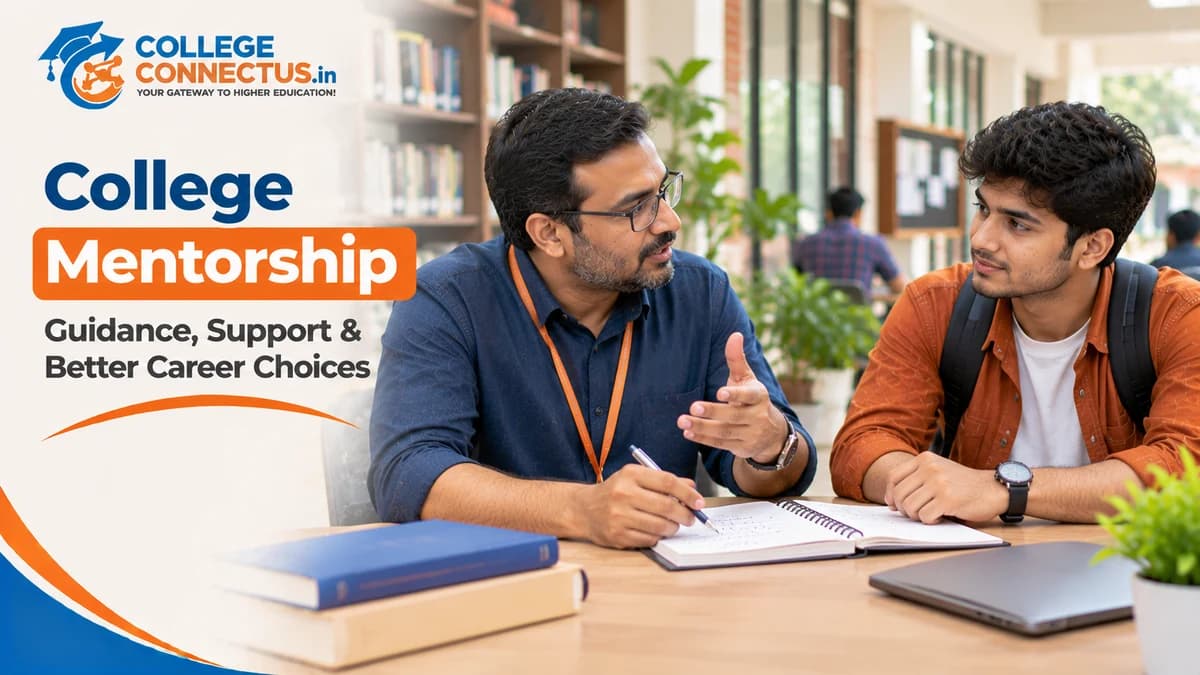
College is an important stage of personal, academic and professional development. Students attend lectures, complete assignments, participate in activities and explore different career opportunities. However, knowing what to do next is not always easy.
You may have questions about selecting a specialisation, improving your academic performance, finding internships, preparing for placements or choosing a career after graduation. While online resources can provide useful information, guidance from someone with relevant experience can help you understand your options more clearly.
This is where a mentor can make a difference.
A mentor is someone who shares knowledge, experience and guidance to help another person develop. In college, a mentor could be a faculty member, senior student, alumnus, working professional or someone with experience in your area of interest.
However, finding a mentor is only the first step. You also need to approach the right person, communicate your goals and build a professional relationship over time.
This guide explains how to find a mentor in college in India, how to approach them and how to make mentorship useful for your academic and career development.
Before searching for a mentor, understand what mentorship involves.
A mentor does not make decisions on your behalf or guarantee academic success, internships or employment. Instead, they help you evaluate situations, understand possible opportunities and learn from their experiences.
Depending on their background, a mentor may help you with:
Understanding subjects and academic expectations.
Selecting a course specialisation.
Identifying skills relevant to your career interests.
Exploring internship and project opportunities.
Preparing for interviews and professional communication.
Understanding industry expectations.
Building confidence in academic and professional situations.
Avoiding common mistakes during your college journey.
For example, a second-year engineering student interested in software development may seek guidance from a faculty member or alumnus working in the technology sector.
The mentor may suggest learning programming fundamentals, completing practical projects and exploring suitable internship opportunities.
The student still needs to do the work. The mentor provides direction and feedback.
Not every mentor has the same experience or expertise. Your choice should depend on the guidance you are looking for.
Faculty members can be useful mentors for academic and research-related questions.
They may help you understand difficult subjects, identify research interests, select project topics and explore higher education options.
Consider approaching a faculty member who teaches a subject related to your interests or has relevant academic experience.
Senior students can share practical information about college life.
They may guide you on:
Managing academic schedules.
Understanding internal assessments.
Participating in college activities.
Preparing for examinations.
Finding suitable student clubs.
Understanding internship application experiences.
A senior student can provide a useful perspective because they have recently experienced similar situations.
College alumni can help you understand how academic learning connects with professional life.
They may share their experiences related to:
Higher education.
Job applications.
Industry expectations.
Career transitions.
Professional networking.
Skill development.
However, remember that career experiences differ. Use alumni advice as one source of guidance rather than treating one person's journey as the only possible route.
A working professional can provide insights into a particular industry or job role.
For example, a student interested in digital marketing may benefit from speaking with someone who has experience in SEO, content marketing or digital advertising.
An industry professional may help you understand the skills, responsibilities and practical challenges associated with a particular role.
Sometimes, another student with stronger experience in a particular area can be a helpful learning partner.
For example, a student who has completed several programming projects may guide a beginner through development tools and project planning.
Peer mentorship can also work in both directions. You may receive guidance in one area while helping another student in a different subject.
One common mistake students make is approaching someone without knowing what they want to learn.
A general request such as "Please guide me about my future" may be difficult for a potential mentor to answer because it does not explain the student's interests or challenges.
Instead, identify one or two specific goals.
You can organise your goals into the following areas:
Area | Example Goal |
|---|---|
Academics | Improve understanding of core subjects |
Specialisation | Decide which subject or domain to explore |
Technical skills | Learn how to build practical projects |
Internships | Understand how to prepare for internship applications |
Career planning | Explore suitable job roles |
Higher education | Understand postgraduate study options |
Communication | Improve professional speaking and writing |
For example, instead of asking, "How can I get a good job?", you could ask:
"I am pursuing BCA and want to explore web development. Which technical skills and practical projects should I focus on before applying for internships?"
A specific question makes it easier for a mentor to understand your requirements and provide relevant guidance.
You do not always need to search outside your college to find a mentor. Many opportunities may already exist within your academic environment.
Start by speaking with your department coordinator, class teacher or faculty members.
Some colleges have formal faculty mentoring systems in which students are assigned mentors for academic and personal development.
Ask whether your department provides:
Faculty-student mentorship.
Academic counselling.
Research guidance.
Career development support.
Alumni interaction programmes.
Student development activities.
If your college has a formal mentorship programme, understand how students are assigned mentors and how frequently meetings are organised.
College activities can help you connect with experienced students, faculty members and professionals.
Consider participating in:
Technical clubs.
Cultural societies.
Entrepreneurship cells.
Coding communities.
Workshops.
Seminars.
College festivals.
Research groups.
Professional development events.
Active participation gives you opportunities to interact with people who share your interests.
Your college alumni network can be another useful source of mentorship.
Ask your department or alumni association whether it organises alumni interactions, career sessions or networking activities.
You can also explore professional networking platforms to identify alumni working in your preferred field.
When contacting an alumnus, introduce yourself clearly and explain why you are interested in learning from their experience.
Workshops, guest lectures, webinars and professional events can introduce you to people working in different industries.
Do not approach every speaker with an immediate request for long-term mentorship.
Start with a relevant question, listen to their suggestions and follow up professionally if they are comfortable continuing the conversation.
Approaching someone for mentorship can feel difficult, particularly if you have never interacted with them before.
The best approach is to keep your introduction polite, brief and specific.
Before contacting someone:
Understand their professional or academic background.
Identify what you want to learn from them.
Prepare one or two relevant questions.
Choose an appropriate communication channel.
Respect their time and availability.
You can use the following message when approaching a faculty member.
Subject: Request for Academic and Career Guidance
Dear Professor,
I am a student of [Course and Year] and have been developing an interest in [Your Area of Interest].
I would appreciate an opportunity to seek your guidance regarding skill development and possible academic or career opportunities in this area.
If your schedule permits, could I request a short meeting at a convenient time?
Thank you for your time and consideration.
Regards,
[Your Name]
Subject: Request for Career Guidance
Hello [Name],
I am currently pursuing [Course Name] at [College Name]. I came across your professional journey and found your experience in [Industry or Domain] relevant to my career interests.
I am exploring opportunities in this field and would appreciate the chance to ask you a few questions about the skills and preparation required.
If you are available, I would be grateful for a brief conversation at your convenience.
Thank you for considering my request.
Regards,
[Your Name]
A message does not guarantee a response. If the person is unavailable or does not reply, respect their decision and avoid sending repeated follow-ups.
Once someone agrees to guide you, prepare before the meeting.
Do not expect the mentor to create your entire academic or career plan without understanding your background.
Prepare a short introduction covering:
Your current course and year.
Your academic interests.
Skills you are learning.
Your short-term goals.
Areas where you need guidance.
Questions you want to discuss.
For example:
"I am a second-year BCA student interested in web development. I understand basic programming concepts and want to improve my practical skills. I would like to understand which projects I should build and how to prepare for an internship."
You can also prepare a list of questions.
Useful questions to ask your mentor:
Which skills should I focus on at my current stage?
What practical projects would help me improve?
What common mistakes should I avoid?
How can I evaluate my progress?
What learning resources or activities would you recommend?
How should I prepare for internships or future opportunities?
Avoid asking questions that can be answered easily through basic research. Use meeting time for questions that benefit from the mentor's experience.
Mentorship is not a one-time conversation. It becomes more useful when both people communicate respectfully and consistently.
However, consistency does not mean contacting your mentor every day.
Follow these practices to build a healthy professional relationship.
Your mentor may have teaching responsibilities, professional commitments and personal priorities.
Schedule meetings in advance whenever possible. Keep discussions focused and follow the agreed meeting duration.
A mentor may identify weaknesses in your approach or suggest changes to your plans.
Listen carefully and ask questions if you do not understand the feedback.
You do not have to accept every suggestion automatically. Evaluate advice based on your circumstances and goals.
One of the best ways to make mentorship meaningful is to act on relevant guidance.
If your mentor recommends completing a project, creating a learning plan or improving communication skills, make a realistic effort to follow through.
At the next meeting, explain what you completed and what challenges you encountered.
Keep your mentor informed about important progress when appropriate.
For example, you may share that you completed a project, participated in a competition or applied for an internship.
This helps the mentor understand whether their suggestions are useful and what guidance you may need next.
A simple thank-you message after a helpful meeting can strengthen professional communication.
Acknowledge the time and effort someone has invested in helping you.
A mentor can support different stages of your college journey.
The type of guidance you need may change as you progress through your course.
Focus on understanding your academic environment.
You may seek guidance about:
Choosing useful extracurricular activities.
Developing effective study habits.
Understanding your course structure.
Building basic technical or subject knowledge.
Exploring different career interests.
A senior student or faculty mentor may be particularly helpful at this stage.
Start developing deeper knowledge in areas that interest you.
Discuss:
Choosing a specialisation.
Building practical projects.
Participating in competitions.
Exploring research opportunities.
Developing communication and teamwork skills.
If you are interested in gaining practical experience, read our guide on how to find internships while studying in college in India.
Your priorities may shift towards employment, postgraduate education or other professional opportunities.
You can discuss:
Resume improvement.
Interview preparation.
Job role selection.
Higher education planning.
Professional networking.
Transitioning from college to the workplace.
Our guide on preparing for campus placements in India can also help you understand the preparation process.
Mentorship can be valuable, but students sometimes approach it with unrealistic expectations.
Here are some common mistakes to avoid.
A mentor cannot guarantee a job, internship, scholarship or admission.
Their role is to provide guidance. Your preparation, decisions and efforts remain your responsibility.
Repeatedly asking broad questions without doing basic research can make conversations less productive.
Prepare questions and explain what you have already tried.
One mentor may have strong knowledge in a particular area but limited experience in others.
For example, a faculty member may provide excellent academic guidance but may not have detailed knowledge of current industry hiring practices.
You can seek guidance from different people for different goals.
If you repeatedly seek advice but do not consider the feedback, you may miss opportunities to improve.
Think carefully about suggestions and decide which ones are suitable for your situation.
Mentorship should support learning and development, not replace effort.
You still need to attend classes, complete assignments, develop skills and take responsibility for your decisions.
A mentoring relationship should remain respectful and appropriate.
Avoid demanding immediate replies, sharing confidential information unnecessarily or expecting your mentor to be available at all times.
If a mentoring interaction makes you uncomfortable, you can step away and seek guidance from an appropriate college authority.
It can be difficult to measure the value of mentorship through a single outcome.
Instead, review whether your understanding, skills and decision-making are improving.
You can maintain a simple progress tracker.
Development Area | What to Track |
|---|---|
Academic learning | Topics understood and subjects improved |
Technical skills | Skills learned and projects completed |
Career awareness | Job roles and career options explored |
Communication | Presentations, discussions and professional interactions |
Practical experience | Internships, projects and competitions |
Personal development | Confidence, planning and decision-making |
Review your progress every month or after a few mentoring sessions.
Ask yourself:
Have I become clearer about my goals?
Have I completed the actions discussed with my mentor?
Have I developed any new skills?
Can I make better-informed decisions?
What do I need to improve next?
This approach helps you turn general advice into measurable development.
Not every student has immediate access to a formal mentoring programme.
If your college does not provide one, you can still explore other ways to receive guidance.
Consider the following options:
Build relationships with faculty members: Start by asking relevant academic questions and participating in classroom discussions.
Connect with seniors: Ask students who have completed similar subjects, projects or internship applications to share their experiences.
Explore alumni networks: Check whether your college has an alumni association or professional networking group.
Join learning communities: Participate in student communities related to programming, business, research, design or other interests.
Attend career events: Guest lectures and workshops can help you interact with professionals and learn about different career paths.
Create a personal learning plan: Identify your goals, research available opportunities and review your progress regularly.
You do not need to wait for a formal mentorship arrangement to start improving yourself.
Finding a mentor in college can help you understand academic expectations, explore career opportunities and make more informed decisions.
The right mentor may be a faculty member, senior student, alumnus, industry professional or peer with relevant experience.
Start by identifying what you want to learn. Approach potential mentors professionally, prepare specific questions and respect their time. Most importantly, take action on useful guidance and review your progress.
Remember that mentorship is a learning relationship, not a shortcut to success. The greatest benefit comes when you combine another person's experience with your own effort, curiosity and willingness to improve.
As you explore your college journey, use the academic, career and student resources available on College Connect Us to make more informed decisions about your education and future.
A college mentor provides guidance related to academics, skill development, career planning and personal development. They share experience, offer feedback and help students evaluate different opportunities.
You can approach faculty members, senior students, alumni and industry professionals. You can also explore college mentorship programmes, student clubs, alumni networks, workshops and professional events.
Yes. A senior student can guide you about academic routines, college activities, examinations, projects and practical experiences. Peer mentorship can be especially useful when you are adjusting to college life.
Introduce yourself politely, explain your academic interests and mention the specific guidance you need. Ask whether they are available for a short meeting rather than immediately expecting a long-term commitment.
There is no fixed schedule for every mentoring relationship. You can mutually decide a suitable frequency based on your goals and the mentor's availability. Even occasional, well-prepared discussions can be useful.
Yes. A mentor with relevant professional experience may help you understand industry expectations, improve your resume, identify skill gaps and prepare for interviews. However, placement outcomes depend on several factors, including your preparation and the opportunities available.
Yes. You can seek guidance from different people for different areas. For example, a faculty member may guide you academically, while an alumnus may share industry experience.
Respect their availability. You may send one polite follow-up after a reasonable interval. If they remain unavailable, consider approaching another suitable person or exploring your college's mentorship resources.
No. Mentorship usually involves an ongoing relationship in which someone shares experience and guidance. Career counselling may be a more structured process focused on evaluating interests, career options and professional decisions.
Look for someone with relevant knowledge or experience, good communication skills, a willingness to guide, respect for boundaries and an ability to provide constructive feedback. A good mentor should encourage independent thinking rather than make every decision for you.
Explore expert articles, admission guides, career tips, education news, exam preparation, and everything you need to make informed academic decisions.