
College Connect
Preparing your experience...
Preparing your experience...

Need help? 👋
We're here to help you
Looking for the right college, course or admission guidance? Choose an option below.
A practical guide to using a college library, including book searches, digital resources, research methods, citation practices, study-space etiquette, and strategies for making the most of academic resources.
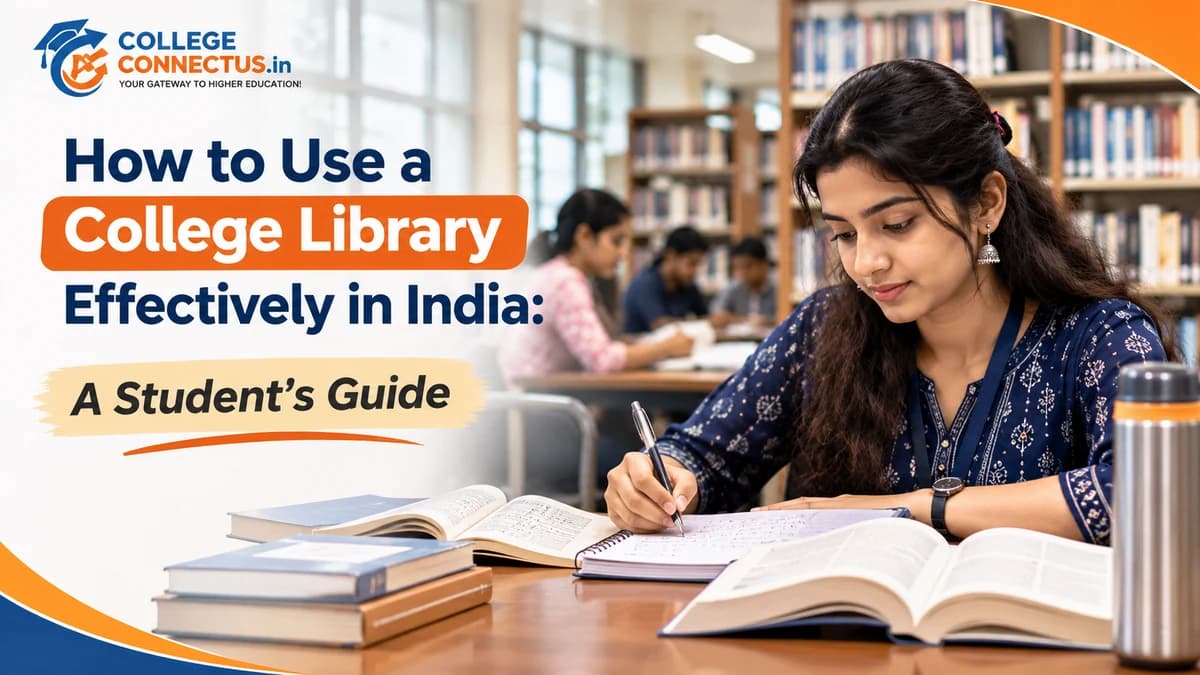
A college library can be one of the most useful resources available to students. It provides access to textbooks, reference materials, academic journals, research resources, study spaces and, in some institutions, digital databases.
However, having access to a library does not automatically mean that you know how to use it effectively.
Students may struggle to find the right books, identify reliable information for assignments, use digital catalogues or organise research notes. Others visit the library only during examinations and miss opportunities to use its resources throughout the semester.
Learning how to use a college library can make academic work more organised and help you develop independent research skills.
This guide explains how college libraries work, how to find relevant materials, how to use digital resources, and how to make library visits more productive.
The first step is to find out what your college library offers.
Facilities vary between institutions, courses and campuses. A large university may provide extensive digital databases and specialised research collections, while a smaller college may focus primarily on textbooks, reference books and reading spaces.
During your first visit, ask the librarian or library staff about the available resources.
These may include:
Prescribed textbooks for your course.
Reference books and subject encyclopaedias.
Academic journals and periodicals.
Newspapers and magazines.
Previous examination papers, where available.
Project reports and dissertations, where permitted.
Digital books and academic databases.
Computers or internet access.
Quiet reading areas.
Group-study spaces.
Reference and research assistance.
Do not assume that every resource is available in every college.
Ask whether you can borrow materials, whether some books must remain inside the library, and whether digital resources can be accessed outside campus.
Understanding these facilities helps you choose the right resource for each academic task.
Some institutions automatically activate library access when students enrol. Others require a separate registration process.
Check the library's membership rules and find out whether you need a student identity card, registration number or online account.
During registration, clarify:
How to activate your library membership.
How to access the library catalogue.
How many books you may borrow.
The standard borrowing period.
Whether renewals are permitted.
How to reserve books.
What happens when a book is returned late.
How to report a lost or damaged book.
Whether special access is required for digital resources.
Keep your login details secure and follow the institution's rules.
If your library provides an online account, learn how to view borrowed books, check due dates and renew eligible items.
Completing these basic steps early can prevent avoidable problems when you need a book for an assignment or examination.
Finding the correct book is an important research skill.
Many college libraries use an online public access catalogue, commonly called an OPAC. Others provide a searchable catalogue through their website or library-management system.
A catalogue may allow you to search by:
Book title.
Author's name.
Subject.
Keyword.
ISBN, where available.
Department or collection.
Suppose you need material about database management.
Searching for a broad term such as “computers” may return many unrelated results. A more specific search, such as “database management systems,” may help you identify relevant textbooks.
Once you find a result, check the available details.
Look for:
The full title.
Author or editor.
Edition and publication year.
Call number or shelf location.
Availability status.
Whether the item is available for borrowing or reference use.
If the catalogue shows that the book is available but you cannot locate it, ask the librarian for assistance.
A textbook may have several editions. For subjects involving changing standards, technologies, laws or examination requirements, the edition can matter.
Check your course instructions before choosing a version.
You do not always need the newest edition for every subject, but you should understand why you are using a particular one.
Not every book serves the same purpose.
A prescribed textbook is often useful for understanding the topics covered in your syllabus. A reference book may provide a deeper explanation, while a specialised academic publication may be better suited to a research assignment.
Before borrowing a book, consider what you need it for.
Academic task | Resource to consider |
|---|---|
Understanding a syllabus topic | Prescribed textbook |
Clarifying a difficult concept | Reference book or subject guide |
Researching an assignment | Academic books and relevant research articles |
Preparing a presentation | Reliable books, journals and official reports |
Reviewing a topic for an examination | Textbooks, class notes and permitted past papers |
Working on a project | Specialist publications and relevant technical documentation |
Check the assignment instructions before deciding which sources to use.
For example, a project may require recent research papers rather than relying entirely on general textbooks.
If you are unsure, ask your lecturer what types of sources are appropriate.
Many institutions provide access to electronic books, journals and academic databases.
These resources can help students research topics without relying exclusively on printed materials.
Depending on your college's subscriptions, digital resources may include:
E-books.
Scholarly journal articles.
Conference papers.
Research databases.
Subject-specific reference collections.
Electronic theses or dissertations.
Institutional repositories.
Educational publications.
Ask your librarian which services your institution provides and how students are authorised to access them.
Some databases require you to sign in through a college portal or campus network. Others may offer different access arrangements.
Start with the main concept in your assignment.
Then identify related terms, technical phrases or alternative wording used in the subject.
For example, a project about renewable energy may benefit from searches covering solar energy, wind power, energy storage and grid integration.
Use quotation marks when a database supports exact-phrase searching. If the initial results are too broad, add a more specific term or narrow the search by publication date or subject.
Depending on the platform, you may be able to filter results by:
Publication year.
Subject.
Publication type.
Author.
Peer-reviewed status.
Full-text availability.
Filters can reduce irrelevant results, but they should not replace evaluating the quality of each source.
Important: Access to a digital publication does not automatically make it suitable for every assignment. Check its relevance, authority and reliability before using it.
A common mistake is to collect many books and articles before deciding what the assignment actually requires.
A better approach is to define your research question first.
Identify the topic, required length, expected format, deadline and types of evidence requested.
If the instructions are unclear, ask your lecturer before spending hours researching the wrong subject.
Suppose your assignment concerns the impact of digital learning on higher education.
You could divide the topic into:
Access to learning resources.
Student engagement.
Digital accessibility.
Assessment methods.
Limitations of online learning.
These subtopics can guide your search.
Start with a relevant textbook, reference source or academic overview.
This helps you understand the subject's basic concepts and identify terminology for more detailed searches.
Once you understand the topic, search for relevant research papers, academic publications and reliable reports.
Prefer sources that directly address your research question.
For each source, record the author, title, publication details, relevant page numbers and the main point you want to use.
This will make it easier to cite the source accurately later.
Group your notes by theme instead of keeping a long, unstructured collection of copied passages.
This helps you identify patterns, disagreements and gaps in the available evidence.
Effective note-taking is not the same as copying paragraphs from books.
Your notes should help you understand the material and remember where each idea came from.
A practical research note can contain:
Topic or question.
Source title.
Author and publication details.
Relevant page number.
Main idea in your own words.
Useful evidence or quotation.
How the source relates to your assignment.
Any questions that require further research.
If you copy a sentence directly from a source, mark it clearly as a quotation and record its page or location.
When you summarise an idea in your own words, retain the source details so you can cite it correctly.
This distinction reduces the risk of accidentally presenting another author's words or ideas as your own.
Avoid photographing or copying entire books or articles where doing so would violate copyright or library rules.
Use only the portions needed for your legitimate study and follow the applicable access conditions.
When you use another person's ideas, research findings, data or exact words in an assignment, you may need to acknowledge the source.
Referencing helps readers identify the material you used and distinguish your own analysis from the work of other authors.
Your college or lecturer may require a particular referencing style, such as APA, MLA, Chicago or another discipline-specific format.
Before preparing your bibliography, check the required style and edition.
Depending on the style, a reference may include:
Author or organisation.
Publication year.
Title.
Journal or publisher.
Volume and issue.
Page range.
DOI or other identifier, where applicable.
Access details for certain online materials.
Do not assume that all citation styles use the same punctuation or ordering.
If you use a reference-management tool, check the generated citations rather than accepting every entry without review.
Academic integrity matters: Cite the original source when you use its ideas, do not invent references, and never include a publication in your bibliography that you have not actually consulted.
Libraries can be useful throughout the semester, not just before final examinations.
Depending on the resources available, students may use the library to:
Review prescribed textbooks.
Clarify difficult topics.
Compare explanations from different authors.
Access reference material.
Practise with permitted previous examination papers.
Study in a quieter environment.
Prepare revision notes.
Check whether your institution provides past examination papers and whether any restrictions apply.
Do not assume that previous questions will necessarily appear again. Use them to understand question formats and practise applying concepts.
A balanced preparation plan should also include lecture notes, assigned readings, practice questions and feedback from your teachers.
For help organising your study schedule, read How to Manage Time Effectively in College: A Practical Guide for Students in India.
A library visit is most useful when you have a clear goal.
Before arriving, decide what you want to complete.
Examples include:
Reading one assigned chapter.
Finding three relevant sources for an assignment.
Revising a difficult concept.
Preparing notes for a presentation.
Reviewing a research paper.
Organising references for a report.
Choose a few realistic tasks rather than trying to complete an entire project in one session.
Depending on your task, you may need a notebook, laptop, student ID, course materials or a list of references.
Check the library's rules about food, devices, photography and other activities.
Long study sessions can become less productive if you are tired or distracted.
Use a routine that suits your concentration and the library's rules. You might work for a set period, take a brief break where permitted, and then return to the task.
At the end of the session, record what you completed and what remains.
If you borrowed books, check the due dates before you leave.
A college library is a shared learning environment.
Following its rules helps ensure that everyone can use the available resources.
Common expectations may include:
Keeping noise low in designated quiet areas.
Returning books on time.
Handling books and equipment carefully.
Avoiding damage to library materials.
Keeping study spaces tidy.
Following computer and internet-use policies.
Respecting borrowing limits.
Following rules for food and drinks.
Not sharing library credentials with unauthorised users.
Rules vary between institutions, so read the library's guidelines rather than assuming every campus operates identically.
If you need to discuss a group project, use a designated discussion area when available.
If a resource is missing or damaged, report it to library staff instead of trying to resolve the issue by altering the catalogue or equipment yourself.
Sometimes the book you need is already borrowed, under repair or not held by the library.
If that happens, ask about available alternatives.
Possible options include:
Reserving the book.
Checking another edition.
Searching for a different relevant textbook.
Using an authorised e-book.
Requesting an interlibrary loan, if the institution provides one.
Asking whether the library can acquire the resource.
Finding an alternative source recommended by your lecturer.
Do not assume that a book is unavailable everywhere just because your local library does not have it.
At the same time, do not download copyrighted books from unauthorised websites simply because a printed copy is difficult to find.
Ask the librarian about legitimate access options.
Librarians can help with more than issuing and returning books.
Depending on their role and training, they may assist students with catalogue searches, database access, subject collections, referencing resources and research strategies.
Ask for help when:
You cannot find a particular book.
You are unsure how to use the catalogue.
A database requires authentication.
You need research material for a specialised topic.
You want to understand how to access electronic journals.
You need guidance on the library's citation resources.
You want to know whether an item is available through another collection.
Prepare a clear question before approaching the library desk.
For example, instead of saying, “I need information about technology,” explain the topic of your assignment and the type of material you are looking for.
A specific question makes it easier for staff to guide you toward useful resources.
Waiting until examination season can make it harder to find popular textbooks or a suitable study space.
Better approach: Use library resources throughout the semester.
Broad searches can produce too many unrelated results.
Better approach: Define your research question and use specific keywords.
A single textbook may not provide enough evidence for a detailed assignment.
Better approach: Use a suitable combination of textbooks, reference material and relevant research publications.
It becomes difficult to prepare accurate references when source details are missing.
Better approach: Record bibliographic information as you take notes.
A publication being available online does not guarantee its accuracy.
Better approach: Evaluate the author, publisher, evidence, date and relevance of each source.
Late returns may lead to penalties or restrictions, depending on the library's rules.
Better approach: Track due dates and renew books when permitted.
Arriving without a plan can lead to unproductive browsing.
Better approach: Set a specific objective for each visit.
You do not need to spend every free hour in the library to benefit from it.
A manageable routine might look like this:
When | Suggested activity |
|---|---|
Beginning of the week | Review upcoming assignments and identify the resources you need |
During the week | Read assigned chapters and clarify difficult concepts |
Before an assignment deadline | Research supporting sources and organise references |
Before an examination | Review notes and use available practice materials |
End of the week | Return or renew books and plan the next study session |
Adjust this routine to your timetable, workload and available library hours.
Students with laboratory-heavy courses, placements, part-time responsibilities or long commutes may need a different schedule.
The aim is consistency, not the number of hours spent in the library.
Learn the library's rules, register for access, use the catalogue to find resources, prepare specific research questions and keep organised notes. Regular visits can help you make better use of textbooks, reference material and digital resources.
Some institutions provide remote access to electronic books, journals and databases, while others restrict certain resources to campus networks. Ask your librarian how off-campus access works at your college.
OPAC stands for Online Public Access Catalogue. It is a searchable catalogue that helps users locate books and other library materials by title, author, subject or keyword.
Start with your research question and identify relevant keywords. Use the academic databases and research resources available through your college. Evaluate each source for relevance and reliability, and record its publication details for accurate referencing.
The appropriate sources depend on the assignment. Textbooks can help explain core concepts, while research papers may provide specialised findings or current evidence. Follow your lecturer's instructions about source types and minimum requirements.
Ask the librarian about alternative editions, authorised digital access, reservations, interlibrary loans or other legitimate options. You can also ask your lecturer to recommend a suitable alternative.
Write notes in your own words, clearly mark direct quotations, record source details and cite ideas or evidence according to your institution's required referencing style. Do not present another person's work as your own.
Yes. Depending on the collection, it may provide textbooks, reference books, research papers, standards, manuals and other materials relevant to technical subjects. Check which resources are available for your programme.
A college library is more than a place to sit and read. It can help you understand course material, research assignments, develop independent learning habits and prepare for examinations.
Start by learning how your library works. Explore its catalogue, ask about digital access, select suitable sources and record references as you research.
You do not need to use every resource at once. Begin with the materials most relevant to your course and gradually expand your research skills.
The more effectively you learn to find, evaluate and use information, the more valuable your college library can become throughout your academic journey.
Explore expert articles, admission guides, career tips, education news, exam preparation, and everything you need to make informed academic decisions.