
College Connect
Preparing your experience...
Preparing your experience...

Need help? 👋
We're here to help you
Looking for the right college, course or admission guidance? Choose an option below.
Preparing for a technical interview can feel challenging for college students and fresh graduates. This guide explains how to revise technical fundamentals, practise coding problems, present academic projects, answer common questions, participate in mock interviews and avoid frequent mistakes.
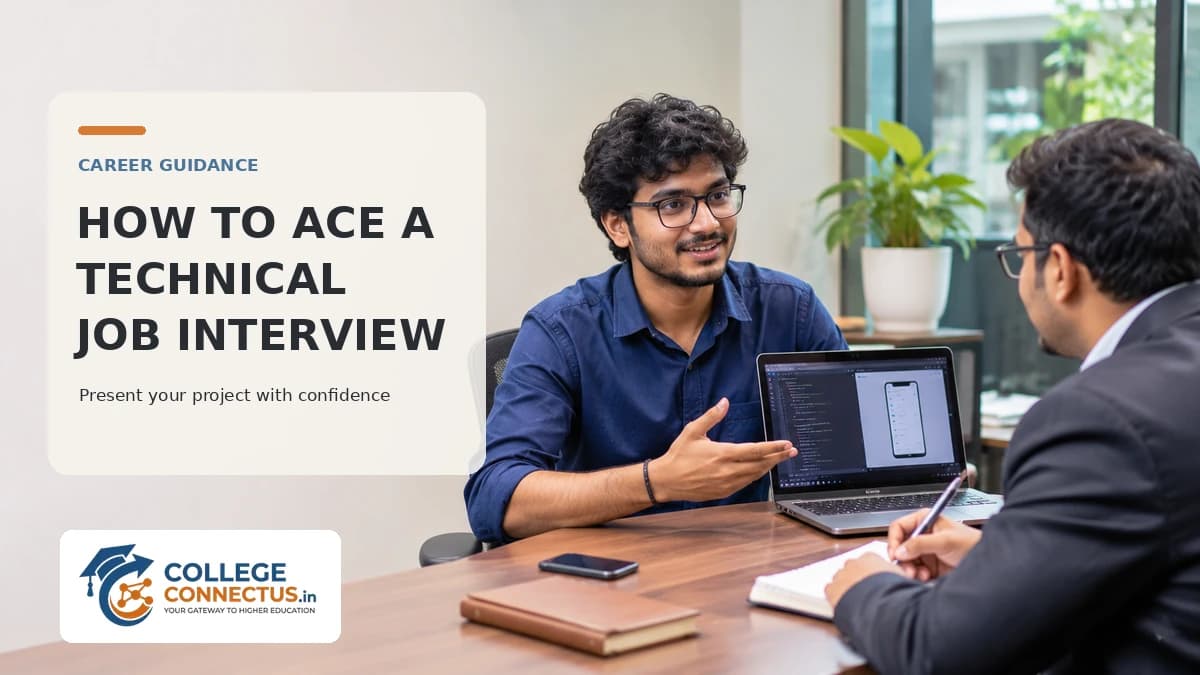
A technical interview is an opportunity to demonstrate what you know, how you solve problems and how you approach unfamiliar challenges. For college students and fresh graduates in India, it may be part of campus placements, off-campus recruitment, internship selection or entry-level hiring.
Many candidates believe they must learn every programming language, memorise hundreds of questions or solve the hardest coding problems to succeed. In reality, effective preparation starts with understanding the role, strengthening relevant fundamentals and practising how to explain your reasoning.
The interview process also differs across employers. A software development position may involve coding problems and data structures, while a technical support role may focus on troubleshooting, operating systems and networking. Other roles may include practical assessments, project discussions or domain-specific questions.
This guide explains how to prepare for a technical interview, organise your study plan, practise common question types, present projects confidently and learn from mistakes.
A technical interview evaluates the knowledge and practical abilities required for a particular role.
Depending on the employer and position, the interview may assess:
Subject knowledge and technical fundamentals
Programming and problem-solving ability
Understanding of algorithms and data structures
Knowledge of databases and computer networks
Practical project experience
Troubleshooting and analytical thinking
Ability to explain technical concepts
Approach to learning unfamiliar tools or technologies
Not every interview tests all these areas. A frontend developer, backend developer, data analyst and technical support engineer may face substantially different questions.
The first rule of technical interview preparation is to prepare for the job you want, not for every possible technical interview.
Before opening a coding platform or watching interview tutorials, read the job description carefully.
The job description helps you identify which skills matter most to the employer.
For example, a junior web developer position may mention JavaScript, HTML, CSS, APIs, Git and a frontend framework. A backend role may emphasise databases, server-side programming, authentication and API design.
Create a simple table with three columns:
Requirement | Your Current Level | Preparation Needed |
|---|---|---|
Programming language | Comfortable with basics | Practise problem-solving |
Data structures | Understand arrays and strings | Revise trees and hashing if relevant |
Database concepts | Basic SQL knowledge | Practise joins and grouping |
Projects | Completed an academic project | Prepare a clear explanation |
Communication | Can explain familiar topics | Practise concise answers |
This exercise helps you distinguish between skills you already understand and areas that need more attention.
If the role lists a technology you have never used, determine whether it is essential or desirable. Prioritise the mandatory requirements and be honest about your current abilities.
Strong fundamentals help you solve problems, answer follow-up questions and understand unfamiliar situations.
The topics you should revise depend on your target role.
Candidates applying for software development positions should review the fundamentals relevant to the advertised technology stack.
Common areas include:
Variables, data types and operators
Conditional statements and loops
Functions and modular programming
Object-oriented programming
Error handling and debugging
Data structures and algorithms
Time and space complexity
Database fundamentals
APIs and HTTP basics
Version control with Git
For frontend positions, revise HTML, CSS, JavaScript and the relevant framework. Be ready to explain how components, state, events and API requests work if those concepts are part of your experience.
For backend positions, revise server-side programming, database operations, API design, authentication and error handling where relevant.
Depending on the job description, you may need to revise:
Operating systems: Processes, threads, memory management, deadlocks and scheduling.
Database management systems: Keys, normalisation, joins, indexes and transactions.
Computer networks: IP addresses, DNS, HTTP, HTTPS, TCP and common networking concepts.
Software engineering: Testing, debugging, version control and the software development lifecycle.
Object-oriented programming: Classes, objects, inheritance, encapsulation, abstraction and polymorphism.
Do not assume every employer will ask all these questions. Use the job description, assessment format and role requirements to prioritise your preparation.
Instead of reading a textbook from beginning to end, use an active-learning approach:
Select one concept.
Explain it in your own words.
Write a small example.
Identify where the concept is useful.
Solve a related problem.
Review mistakes and revise the concept.
If you cannot explain a concept without reading directly from your notes, spend more time understanding it before memorising a definition.
If you are applying for a programming role, coding practice can help you develop a systematic approach to technical problems.
Start with basic questions and gradually increase the difficulty.
Begin with problems involving:
Reversing a string
Checking whether a number is even or odd
Finding the largest element in an array
Counting character occurrences
Checking whether a string is a palindrome
Removing duplicate values
Finding the second-largest element
Calculating the frequency of elements
These exercises help you practise loops, conditions, functions and basic data structures.
Once you are comfortable with the basics, work on topics such as:
Hash maps and frequency counting
Two-pointer techniques
Sliding-window problems
Binary search
Stack and queue operations
Linked lists
Tree traversal
Sorting and searching
Recursion
Basic dynamic programming, when relevant to your target role
You do not need to master every advanced topic before applying for an entry-level job. Prioritise according to the role and the assessment style used by your target employers.
When solving a coding question, follow this process:
1. Understand the problem. Identify the inputs, expected output and constraints.
2. Ask clarifying questions. Confirm assumptions about empty inputs, duplicates, data types or edge cases.
3. Explain your approach. Describe the solution before writing code.
4. Write the solution. Use clear variable names and a logical structure.
5. Test your code. Try normal inputs, edge cases and unexpected values.
6. Discuss complexity. Explain time and space complexity when relevant.
7. Review alternatives. Consider whether a simpler or more efficient solution exists.
For example, if asked to find the largest value in an array, explain why tracking the largest value while traversing the array is sufficient. Then discuss the time complexity of your approach.
Interviewers may evaluate your reasoning as well as the final output. If you become stuck, explain what you have considered and where you need to investigate further.
Your projects are often among the most useful subjects to prepare because they provide concrete examples of your technical work.
A project discussion may cover your design decisions, technology choices, database structure, challenges, testing methods and individual contribution.
Before the interview, prepare a short explanation for each relevant project.
1. Problem: What problem were you trying to solve?
2. Solution: What did you build?
3. Technology: Which languages, frameworks, databases or tools did you use?
4. Contribution: What work did you personally complete?
5. Challenge: What technical difficulty did you encounter?
6. Resolution: How did you investigate and solve it?
7. Outcome: What did you complete, test or improve?
For example, if you built a college management application, you might explain how you designed the database, created APIs, implemented authentication or developed a search feature.
Be precise about your contribution. If the project was completed by a team, distinguish your own work from the work completed by other members.
Prepare for follow-up questions such as:
Why did you choose this technology?
How did you structure the database?
How did you handle errors?
What security considerations did you address?
How did you test the application?
What would you improve if you rebuilt it?
What did you learn from the project?
You should also be able to explain limitations. A thoughtful discussion of what you would improve can demonstrate that you understand the difference between a completed project and a production-ready system.
If you want to organise your project work before interviews, read our guide on how to build a strong college portfolio in India.
There is no universal list of questions that guarantees success. However, practising common question types can help you revise the concepts that employers frequently assess.
Depending on the role, you may be asked:
What is the difference between a compiler and an interpreter?
What is the difference between an array and a linked list?
What is recursion?
What is the purpose of a function?
How do you handle exceptions?
How would you find duplicate elements in a collection?
Do more than memorise definitions. Write small examples and explain when a concept is useful.
Possible topics include:
What is a class and an object?
What is inheritance?
What is encapsulation?
What is polymorphism?
What is abstraction?
How do method overloading and overriding differ?
Prepare examples from a language you know well. For instance, explain how a class represents a structure and how an object represents a particular instance of that class.
Depending on the role, revise questions such as:
What is a primary key?
What is a foreign key?
What is the difference between WHERE and HAVING?
What is a database join?
Why are indexes used?
What is database normalisation?
How would you find duplicate records using SQL?
Practise writing queries instead of relying entirely on theoretical notes.
For a web development position, possible questions include:
What happens when a browser requests a webpage?
What is the difference between frontend and backend development?
What is an API?
What is the difference between authentication and authorisation?
How do you handle form validation?
What is the purpose of HTTP status codes?
How would you troubleshoot a failed API request?
The specific questions depend on the stack and responsibilities of the role.
You may also be asked:
Tell me about a project you built.
Which technical challenge took you the longest to solve?
How did you debug a difficult issue?
What would you change in your project?
How do you learn a new technology?
What do you do when you cannot solve a problem?
Prepare honest, specific answers based on your experience. Avoid claiming that you used tools or techniques you cannot explain.
A candidate may understand a concept but struggle to communicate it clearly under pressure.
Technical interviews often involve explaining your approach, discussing trade-offs and responding to follow-up questions. Practise speaking through your reasoning rather than silently working until you reach an answer.
For a coding problem, you might explain:
What you understand about the requirements
Which approach you plan to use
Why that approach is suitable
Which edge cases you will test
What limitations or alternatives exist
If you do not know an answer, do not invent one.
Instead, explain what you understand, identify the part you are unsure about and describe how you would investigate it. This is more credible than confidently presenting an incorrect explanation.
Clear communication is especially useful when working with other developers, explaining a bug or discussing technical decisions.
A mock interview simulates part of a real interview so you can practise under realistic conditions.
You can ask a friend, classmate, faculty member or experienced professional to conduct one. You can also practise using a timer and recording your answers for review.
Choose a role and prepare a short list of relevant questions.
For a programming role, the session might include:
Five minutes of introductions.
Ten minutes of fundamentals.
Fifteen to twenty minutes of coding or problem-solving.
Ten minutes of project discussion.
Five minutes of feedback.
Adjust the duration and format to match the type of interview you expect.
After the session, evaluate yourself:
Did I understand the question before answering?
Could I explain my reasoning?
Did I test my code?
Did I communicate clearly?
Did I make unsupported claims?
Which topics caused the most difficulty?
Keep a list of mistakes and revisit them during your next practice session.
The objective is not to deliver perfect answers every time. It is to identify weaknesses before they affect a real interview.
If your interview is approaching, use the following schedule as a starting point. Adjust it according to your current skills, the job description and the time available.
Day | Focus Area | Suggested Activities |
|---|---|---|
Day 1 | Role analysis | Review the job description and list required skills |
Day 2 | Technical fundamentals | Revise core concepts and solve short practice questions |
Day 3 | Coding practice | Work on beginner or intermediate problems relevant to the role |
Day 4 | Database and role-specific topics | Practise SQL, APIs, networking or other required subjects |
Day 5 | Project preparation | Review your code and prepare clear project explanations |
Day 6 | Mock interview | Simulate technical questions and review your performance |
Day 7 | Final revision | Revisit mistakes, organise documents and confirm interview logistics |
This plan is a flexible framework, not a guarantee of readiness. If your fundamentals are weak, you may need more time. If you already have strong experience, you may spend more time on role-specific challenges.
Consistent, focused practice is generally more useful than trying to learn every topic in one long session.
Even well-prepared candidates can lose opportunities by making avoidable mistakes.
Memorisation can help with terminology, but it cannot replace understanding. Interviewers may ask follow-up questions that require you to apply the concept.
Better approach: Explain concepts in your own words and practise small examples.
Preparing only general coding questions may leave you unprepared for the actual responsibilities of the role.
Better approach: Prioritise the skills and tools mentioned in the vacancy.
Listing technologies you have barely used may lead to difficult follow-up questions.
Better approach: Describe your actual experience accurately and be clear about what you are still learning.
Writing code before understanding the requirements can create unnecessary errors.
Better approach: Clarify assumptions, explain your approach and test edge cases.
Some candidates spend all their preparation time on coding questions and overlook the projects listed on their resumes.
Better approach: Review your own code and prepare to explain the decisions behind it.
A technically correct answer may still be difficult to evaluate if your explanation is unclear.
Better approach: Practise explaining your reasoning step by step.
An unfamiliar problem does not necessarily mean the entire interview has gone badly.
Better approach: Explain what you know, consider simpler approaches and ask clarifying questions where appropriate.
When invited to ask questions, use the opportunity to understand the role and the team's expectations.
You might ask what a typical first project looks like, how new employees receive technical guidance or which skills are most important during the first few months.
The final stage is to make sure practical issues do not distract you from the interview itself.
Test your internet connection, microphone and camera.
Check that the required software or interview platform works.
Keep your resume and project notes accessible.
Choose a quiet environment where you can concentrate.
Confirm the interview time and time zone if relevant.
Check whether the employer expects you to share your screen or use a particular coding environment.
Confirm the location, reporting time and contact details.
Plan your route and allow enough time for travel.
Carry the documents requested by the employer.
Review the job description and your project notes.
Follow the employer's instructions about identification or entry procedures.
Listen carefully, clarify questions, communicate honestly and remain open to feedback.
If you make a mistake, acknowledge it and try to correct it. A single mistake does not necessarily determine the outcome of an interview.
After the interview, record the questions you remember and identify topics to revise for future opportunities. Avoid sharing confidential interview material or proprietary assessment content.
Preparation time depends on your current knowledge, the job requirements and the interview format. A candidate with strong fundamentals may need focused revision, while someone learning core concepts may require several weeks or longer.
Choose a language you understand well and that is accepted by the employer's assessment process. Focus on writing correct code, explaining your logic and understanding the language's fundamentals rather than switching languages solely because a tutorial recommends it.
For many software development roles, data structures and algorithms are important assessment areas. However, their depth varies by employer and role. Review the job description and expected assessment format to determine how much time to allocate.
Yes, candidates may qualify for entry-level roles based on their skills, projects, academic work and performance during the selection process. Requirements vary by employer. Be ready to explain what you have built and what you learned.
There is no universally correct number. Solving a few problems carefully, understanding alternative approaches and reviewing mistakes can be more useful than completing many questions without learning from them.
Memorise essential terminology if it helps, but prioritise understanding. Practise explaining concepts with examples so you can respond to follow-up questions.
Stay honest. Explain what you understand, identify the gap in your knowledge and describe how you would approach the problem. Do not invent facts or claim expertise you do not have.
No. Interview formats differ by company, role, seniority and recruitment process. Some involve coding tests, while others focus more on technical discussions, projects or practical troubleshooting.
Before your interview, confirm that you have:
Read and understood the job description.
Identified the most relevant technical topics.
Revised important fundamentals.
Practised role-appropriate coding or practical problems.
Prepared explanations for your projects.
Reviewed your resume for accuracy.
Completed at least one mock interview, if possible.
Practised explaining your thought process.
Identified and revised common mistakes.
Confirmed the interview time, format and required documents.
Prepared a few questions about the role and team.
Preparing for a technical interview is not about knowing every answer. It is about developing a strong foundation, practising relevant problems and communicating your knowledge clearly.
Start by understanding the role, revise the technical concepts it requires, practise solving problems and prepare to explain your own projects. Use mock interviews to identify weaknesses and treat every interview as an opportunity to learn.
For college students and fresh graduates in India, a structured preparation plan can make the process more manageable. Focus on steady improvement, honest communication and practical understanding rather than trying to memorise every question available online.
Explore expert articles, admission guides, career tips, education news, exam preparation, and everything you need to make informed academic decisions.