
College Connect
Preparing your experience...
Preparing your experience...

Need help? 👋
We're here to help you
Looking for the right college, course or admission guidance? Choose an option below.
Group projects help college students develop teamwork, communication, planning, and problem-solving skills. Learn how to choose team roles, divide responsibilities fairly, set deadlines, manage disagreements, and prepare a successful college project in India.
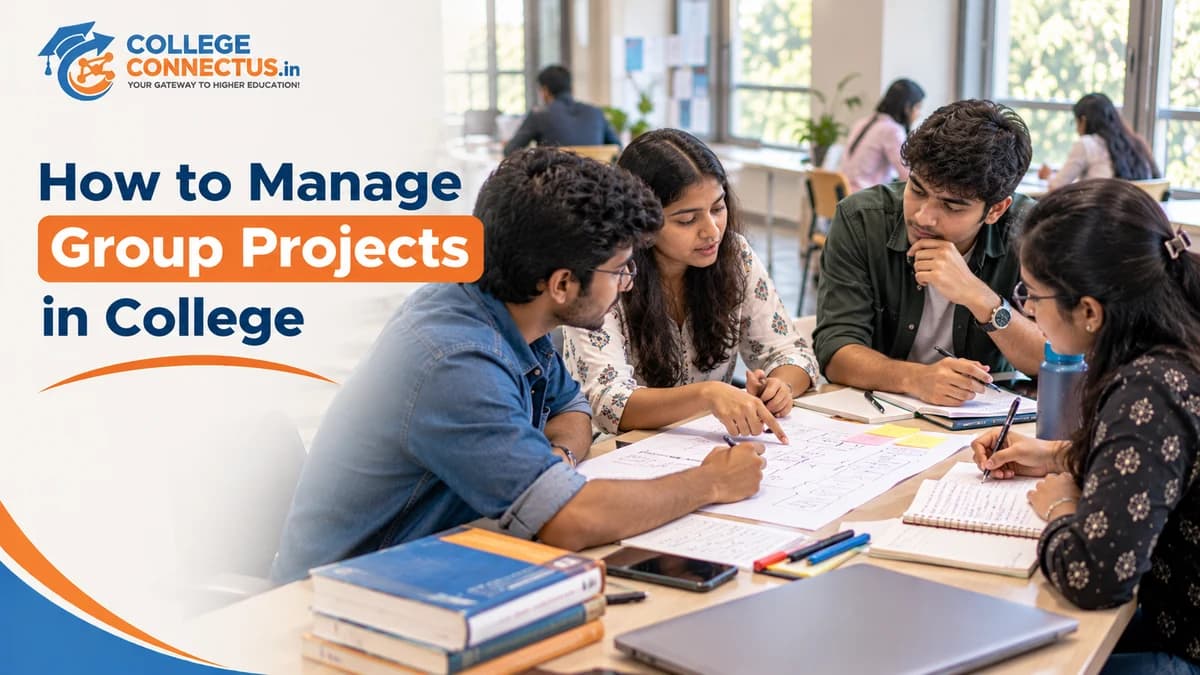
Group projects are an important part of college life. Whether you are studying engineering, management, commerce, computer applications, science, or humanities, you may need to work with classmates to complete assignments, conduct research, build a prototype, prepare a presentation, or solve a practical problem.
Working in a group can make a project more interesting because students bring different ideas, experiences, and skills. However, group assignments can also become challenging when responsibilities are unclear, deadlines are missed, communication breaks down, or one student ends up doing most of the work.
The solution is not simply to divide the assignment into equal parts. A successful college project requires planning, accountability, communication, and regular progress reviews.
In this guide, you will learn how to manage group projects in college in India, divide work fairly, handle disagreements, meet deadlines, and prepare a professional final submission.
One of the most common mistakes students make is starting work immediately without fully understanding the assignment.
Before dividing tasks, read the instructions provided by your professor or department. Identify what the team must deliver and how the final work will be evaluated.
For example, an engineering project may require a working prototype, technical documentation, testing results, and a presentation. A management assignment may involve market research, data analysis, recommendations, and a written report.
Your first team discussion should answer these questions:
What is the main objective of the project?
What problem are we trying to solve?
What deliverables must we submit?
What is the submission deadline?
Are there specific formatting or presentation requirements?
Does every team member need to participate in the presentation?
Will marks be awarded individually, collectively, or through a combination of both?
Are there rules about research sources, originality, or the use of AI tools?
Write down the answers so that every team member understands the same expectations.
If anything is unclear, ask the professor for clarification before committing significant time to the wrong approach.
Practical tip: Convert the assignment instructions into a checklist. The team can use this checklist to verify that every requirement has been addressed before submission.
Once you understand the requirements, define what your team wants to accomplish.
A vague goal such as "complete the project on time" does not explain what successful completion looks like.
A more useful goal would be:
"Submit a research report with verified findings, clear analysis, practical recommendations, and a presentation by the department deadline."
For a technical project, the goal might be to develop a working application, test its main features, document the implementation, and demonstrate the results.
A clear goal helps the team make decisions about scope, responsibilities, and priorities.
Instead of treating the assignment as one large task, divide it into stages.
For example:
Project Stage | Main Activities | Expected Output |
|---|---|---|
Planning | Understand requirements and choose an approach | Approved project plan |
Research | Collect information and review relevant material | Research notes and references |
Development | Complete the main project work | Draft report, prototype, or analysis |
Integration | Combine contributions from team members | Complete working draft |
Review | Check quality, accuracy, and consistency | Revised project |
Presentation | Prepare slides and practise delivery | Final presentation |
Submission | Verify all requirements and submit | Completed assignment |
The exact stages will depend on the type of assignment.
For a short project, some stages may happen on the same day. For a semester-long project, each stage may need several weeks.
The important point is to establish a shared understanding of what needs to happen and in what order.
A group project becomes easier to manage when every member understands their responsibilities.
However, assigning tasks only according to friendship or convenience can create problems. One student may be strong in research, another in programming, another in design, and another in explaining ideas.
Use these differences to your team's advantage.
Project coordinator
The coordinator maintains the task list, checks progress, schedules meetings, and helps the team resolve coordination problems.
This role does not give one student the right to control every decision. The coordinator's purpose is to keep the team organised.
Research lead
The research lead helps identify credible sources, organises findings, checks references, and ensures that claims are supported by evidence.
Technical or subject lead
For technical assignments, this person may coordinate development, calculations, experiments, data analysis, or other subject-specific work.
Documentation lead
The documentation lead maintains the report structure, formatting, references, and version consistency.
Presentation lead
This person coordinates the slides, visual consistency, speaking order, and rehearsal schedule.
These roles are examples rather than fixed positions. A team of three students may combine several responsibilities, while a larger team may assign more specialised tasks.
A student who is good at writing should not automatically become responsible for the entire report. Similarly, a student who understands programming should not be expected to complete every technical task alone.
Assign ownership while ensuring that the workload is realistic.
Also, make sure every member has a meaningful contribution that they can explain during the final evaluation.
One of the biggest challenges in group assignments is unequal participation.
A simple division such as "you do research, I will write the report, and someone else will make the presentation" may not be sufficient. Some tasks require much more time than others.
For example, preparing ten presentation slides may take less time than collecting, cleaning, and analysing a large dataset.
To divide work fairly, consider:
The estimated time required for each task.
The difficulty of the work.
Each student's relevant skills.
The availability of team members.
Dependencies between tasks.
The need for review and revision.
A shared task tracker can prevent confusion.
Task | Owner | Deadline | Status |
|---|---|---|---|
Finalise project topic | Member A | Day 1 | Complete |
Collect research material | Member B | Day 3 | In progress |
Prepare initial analysis | Member C | Day 5 | Not started |
Draft report sections | Members A and B | Day 7 | Not started |
Review and combine sections | Member C | Day 9 | Not started |
Prepare presentation | All members | Day 10 | Not started |
Final quality check | All members | Day 11 | Not started |
This is only an example. Replace the roles, dates, and tasks according to your actual project.
Notice that each task has a clear owner and a deadline. If a task requires contributions from multiple students, identify who is responsible for coordinating it.
A shared tracker is more reliable than depending entirely on messages sent in a group chat.
Students often underestimate the time needed for a project.
They may plan to finish the report one day before submission, only to discover that the research is incomplete or the different sections do not fit together.
To prevent this problem, work backwards from the official deadline.
Suppose your professor expects the final submission in two weeks.
Your team could plan to:
Complete planning during the first two days.
Finish the research by Day 4.
Complete individual contributions by Day 7.
Combine the work by Day 9.
Review and revise the report by Day 11.
Finish the presentation by Day 12.
Conduct the final check by Day 13.
Submit by the official deadline on Day 14.
This schedule is illustrative, not a universal rule. A complex technical project may need a much longer development and testing period.
Internal deadlines provide time to identify mistakes before the actual submission date.
If one team member is delayed, the group has an opportunity to adjust the plan rather than discovering the problem at the last moment.
Set deadlines that are achievable alongside classes, examinations, internships, and other responsibilities.
If your team is struggling to balance assignments with other commitments, the principles in our guide on how to manage time effectively in college can help you organise study hours, project work, and personal responsibilities.
Important: An internal deadline should be treated as a commitment, not an arbitrary date. Team members should communicate early if they anticipate a delay.
A group project does not require constant messaging. It requires the right information to reach the right people at the right time.
Before starting, agree on how your team will communicate.
For example:
Use one group chat for urgent updates.
Maintain one shared document for project requirements.
Keep task assignments in a common tracker.
Store final files in a clearly organised folder.
Record important decisions after team meetings.
Notify the group when a task is completed or delayed.
Avoid keeping different versions of the same report across multiple personal devices without a clear naming system.
File names such as report_final.docx, report_final2.docx, and report_latest_revised.docx can quickly become confusing.
A better naming convention includes the project name, document purpose, and version where appropriate.
For example:
College_Project_Report_v03.docx
For collaborative documents, use a shared editing environment when possible. Agree on who can make structural changes to the final document so that important sections are not accidentally overwritten.
Regular meetings can help the team identify problems early.
A 10–20 minute meeting may be enough for a small assignment. Larger projects may require more detailed discussions.
Use three simple questions:
What have you completed since the last meeting?
What will you work on next?
Are you facing any obstacle that requires help?
Keep the discussion focused on progress and decisions.
If a meeting ends without clear action items, write down the decisions, the responsible people, and the deadlines before everyone leaves.
Different opinions are normal in collaborative work.
One student may prefer a simple solution, while another wants to add more features. Two members may disagree about the research method, presentation format, or division of responsibilities.
Disagreement is not necessarily a problem. It becomes a problem when the discussion turns personal or prevents the team from making decisions.
Instead of saying:
"Your idea is wrong."
Try:
"Can we compare both approaches against the assignment requirements and choose the one that best fits our deadline?"
This changes the discussion from personal criticism to objective evaluation.
When comparing alternatives, consider:
Relevance to the assignment.
Accuracy and quality.
Available evidence.
Time required.
Resources available.
Technical feasibility.
The professor's stated expectations.
If the team still cannot agree, ask the professor or project supervisor for guidance rather than allowing the disagreement to delay the assignment indefinitely.
Start by discussing the situation privately and respectfully.
A missed deadline may result from unclear instructions, competing academic responsibilities, technical difficulties, or personal circumstances.
Explain which task is delayed, how the delay affects the project, and what needs to happen next.
For example:
"The data analysis was expected yesterday, and we need it before we can finish the report. Can you confirm when you can complete it? If the current task is too large, let's discuss how to divide it differently."
If the issue continues, document the assigned responsibilities and progress updates. Inform the professor when appropriate, particularly if the situation affects academic fairness or the submission deadline.
Do not wait until the final day to raise a serious coordination problem.
A group assignment can contain good individual work and still produce a weak final submission.
This happens when team members write separate sections without coordinating terminology, structure, formatting, or conclusions.
For example, one section may use outdated figures while another uses newer data. A technical report may describe a feature that the final prototype does not actually support.
The integration stage is therefore essential.
Before writing separate sections, agree on:
The report outline.
Heading and subheading styles.
Citation and referencing format.
Terminology and abbreviations.
Table and figure formats.
The expected level of detail.
The overall argument or project objective.
Once the individual sections are ready, assign someone to coordinate the review.
That person should check the overall structure, but every contributor remains responsible for the accuracy of their own work.
Review the report as one complete document.
Ask:
Does the introduction explain the same objective as the conclusion?
Are important terms used consistently?
Do the findings support the recommendations?
Are tables and figures explained in the text?
Are sources cited where required?
Does the report answer the professor's original question?
Are there unnecessary repetitions?
Are any claims unsupported by evidence?
If the project includes software, a model, an experiment, or a prototype, verify that the documentation matches the actual result.
This step improves the quality of the submission and helps every team member understand the complete project.
Students do not need an expensive project management system to complete a successful group assignment.
A shared spreadsheet, a collaborative document, a calendar, and a communication channel may be sufficient for many college projects.
Choose tools according to the work rather than adopting multiple applications without a clear purpose.
Useful capabilities include:
Task management: Assign owners, set deadlines, and track progress.
Collaborative editing: Allow team members to contribute to shared documents.
Cloud storage: Keep files organised and accessible to authorised team members.
Calendar reminders: Help the group remember meetings, reviews, and submission dates.
Version history: Make it easier to identify changes and recover earlier work when supported by the platform.
For technical projects, version control may be useful for managing source code and reviewing contributions.
Keep access permissions appropriate for the project. Do not share passwords, confidential information, or personal data unnecessarily.
AI tools can assist with brainstorming, outlining, explaining unfamiliar concepts, checking grammar, or identifying areas that require further research.
However, generated information may contain errors, outdated claims, or references that do not exist.
Verify important information using reliable sources and your course material. Follow your institution's rules on AI use, originality, citations, and disclosure.
Do not submit generated work without reviewing it, and do not use AI as a substitute for understanding the project.
Every team member should be able to explain the methods, decisions, and findings in their own words.
A presentation is often an important part of a college project, even when the written report is the main deliverable.
Do not leave presentation preparation until the last few hours.
First, identify the main message you want the audience to understand. Then organise the slides around the problem, approach, findings, and conclusion.
A typical presentation structure may include:
Project title and team members.
Background and problem statement.
Objectives and scope.
Methodology or approach.
Main work completed.
Results, findings, or demonstration.
Challenges and limitations.
Conclusion and future improvements.
Adapt the structure to your subject and professor's instructions.
Every presenter should know which section they will explain and how it connects to the next speaker's section.
Practise transitions so the presentation feels like one coordinated explanation rather than several unrelated speeches.
Prepare for questions about the methodology, evidence, limitations, and individual contributions.
Do not memorise every sentence without understanding the content. A better approach is to understand the main points and practise explaining them clearly.
Students who want to improve their presentation and professional communication can also explore our guide on how to improve communication skills for college students and freshers in India.
Group projects are not only about earning marks.
When managed properly, they provide opportunities to practise skills that can be useful in internships, research, entrepreneurship, and employment.
These include:
Communication: Explaining ideas, asking questions, listening, and providing constructive feedback.
Planning: Breaking complex work into manageable tasks and setting realistic milestones.
Accountability: Completing assigned work and communicating delays early.
Problem-solving: Evaluating alternatives and finding practical solutions.
Collaboration: Working with people who have different strengths and approaches.
Presentation: Explaining findings to an audience in a clear and structured way.
Documentation: Recording decisions, methods, evidence, and results accurately.
These skills can also support your professional development. For example, the work you complete in a group project may contribute to a portfolio when the assignment permits you to share it publicly.
Our guide on how to build a strong college portfolio in India explains how students can present relevant projects, practical work, and skills appropriately.
Before adding a college assignment to a public portfolio, check your institution's rules and obtain permission where necessary. Avoid publishing confidential research, restricted data, or another student's work without authorisation.
Even a motivated team can lose time through avoidable mistakes.
Beginning research or development before agreeing on the requirements can lead to duplicated effort and inconsistent results.
Better approach: Define the objective, deliverables, roles, and milestones before starting substantial work.
When everyone is responsible for a task, no one may take responsibility for completing it.
Better approach: Assign one primary owner to each task, even when several members contribute.
Late communication leaves little time to change the plan.
Better approach: Review progress regularly and raise concerns as soon as they arise.
A coordinator should help the team move forward, not remove other members from the decision-making process.
Better approach: Agree on how decisions will be made and give everyone a reasonable opportunity to contribute.
Unverified information, inappropriate copying, and missing citations can damage the credibility of the final work.
Better approach: Verify claims, cite sources, respect academic integrity requirements, and review the work before submission.
A report may contain missing sections, inconsistent formatting, incorrect figures, or an incomplete reference list.
Better approach: Reserve time for a final quality check and use the assignment requirements as a checklist.
A student who has worked on only one section may struggle to explain the overall result during evaluation.
Better approach: Ask each member to review the complete report and understand the major decisions, findings, and limitations.
Use this checklist before your next group assignment.
Read the assignment instructions carefully.
Confirm the objective and expected deliverables.
Discuss the project scope with your team.
Identify individual strengths and availability.
Assign responsibilities and task owners.
Create a shared tracker and timeline.
Communicate progress regularly.
Complete work according to agreed deadlines.
Raise obstacles early.
Keep documents and files organised.
Record important decisions.
Review each other's work constructively.
Check that research and data are accurate.
Follow academic integrity and AI-use rules.
Combine all sections into one consistent document.
Check the project against the original requirements.
Verify citations, references, tables, and figures.
Test the prototype or review the final analysis, where relevant.
Proofread the report.
Practise the presentation if required.
Confirm that all required files are included.
Submit through the correct channel before the deadline.
The checklist can be adapted to a short classroom assignment, a semester project, a research report, or a final-year project.
Start by understanding the assignment requirements, setting a clear goal, dividing work according to skills and workload, assigning task owners, and creating realistic deadlines. Use regular progress updates and reserve time to combine and review the final work.
Break the assignment into specific tasks and estimate the effort required for each one. Assign responsibilities according to relevant skills, availability, and workload. Give every task an owner and deadline, and make sure all members contribute meaningfully.
Discuss the issue respectfully and clarify the outstanding task, its deadline, and the effect of the delay. Offer a practical way to resolve the problem if necessary. If the issue continues, keep a record of responsibilities and contact the professor when appropriate.
A shared spreadsheet can track tasks and deadlines, collaborative documents can support joint writing, cloud storage can organise files, and calendars can help schedule meetings. Technical teams may also use version control. Select tools that suit the assignment and your institution's requirements.
Break the project into smaller milestones, set internal deadlines before the official submission date, check progress regularly, and communicate delays early. Reserve time for integration, proofreading, testing, and final submission.
Group projects can help students practise communication, planning, collaboration, problem-solving, documentation, and presentation. These skills can be relevant to internships and employment, although the value depends on the quality of the work and how actively students participate.
Discuss the issue calmly, focus on the assignment requirements, compare alternatives using evidence, and agree on a decision-making process. If the disagreement cannot be resolved, ask the professor or project supervisor for guidance.
Managing a group project successfully requires more than dividing an assignment among classmates. It involves understanding the objective, assigning responsibilities fairly, setting realistic deadlines, communicating consistently, and reviewing the final work together.
The most effective teams do not necessarily have members with identical skills or opinions. They have a shared goal, clear responsibilities, respect for different contributions, and a practical system for solving problems.
Whether you are preparing a classroom presentation, developing a technical prototype, conducting research, or completing a semester assignment, these habits can make collaboration more productive and less stressful.
Start your next college project with a clear plan, a shared task tracker, and realistic deadlines. Small organisational improvements can make a significant difference to the quality of your team's work.
Explore more student resources on College Connect Us to make informed academic decisions and develop practical skills throughout your college journey.
Explore expert articles, admission guides, career tips, education news, exam preparation, and everything you need to make informed academic decisions.