
College Connect
Preparing your experience...
Preparing your experience...

Need help? 👋
We're here to help you
Looking for the right college, course or admission guidance? Choose an option below.
Online resources can make college learning more flexible, but not every website, video or set of notes is accurate or suitable for your course. Discover how to choose trustworthy study materials, compare learning resources, organise digital notes and use online tools effectively.
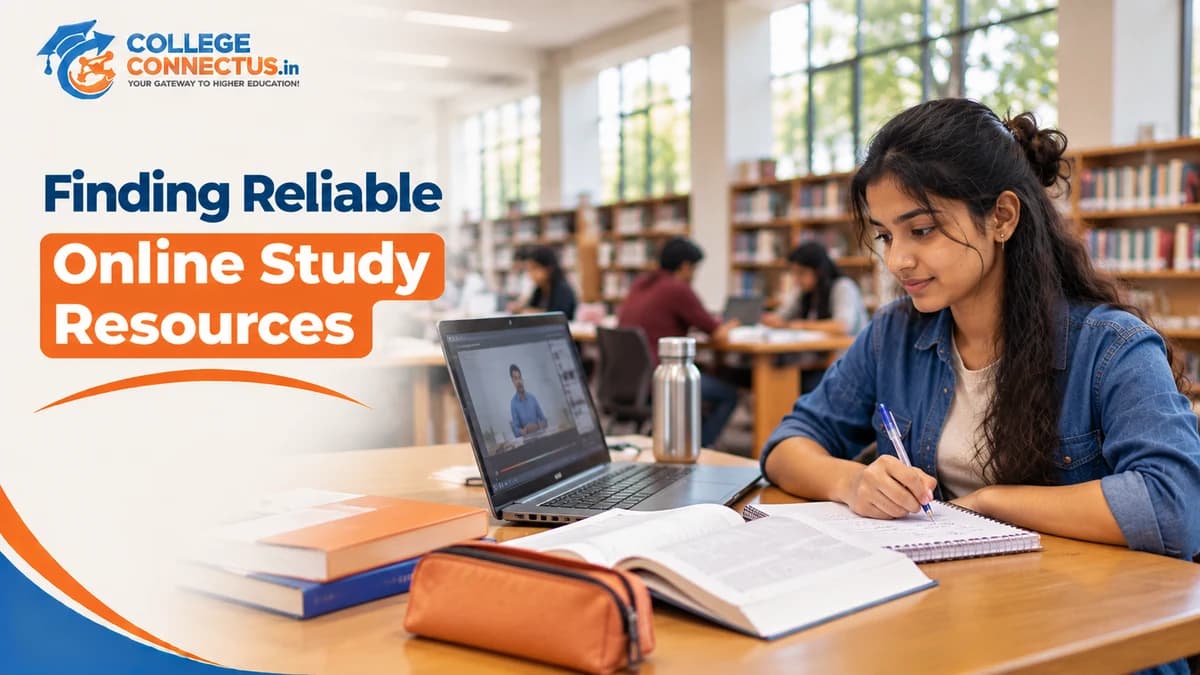
Online learning resources have changed how college students study. Instead of relying only on classroom notes and printed textbooks, students can explore recorded lectures, digital libraries, academic articles, practice questions, subject tutorials and online learning platforms.
These resources can be especially useful when a topic is difficult to understand in class, a student needs additional practice before an examination or course materials are not easily available locally.
However, finding information online is not the same as finding reliable information. Some resources may be outdated, incomplete, poorly explained or unrelated to a college's syllabus. Spending hours watching educational videos can also create the impression of studying without ensuring that the material has been understood.
The key is to select resources based on your learning goals, verify their quality and use them as part of a structured study routine.
This guide explains how college students in India can find useful online study materials, assess their reliability, organise digital resources and avoid common mistakes.
Online resources can support learning in several ways.
Flexible access: Students can revisit recorded explanations or read digital materials when their schedules allow.
Additional explanations: A different teacher or example may help clarify a topic that was difficult to understand during a lecture.
Subject-specific practice: Some resources offer exercises, quizzes, worked examples and practice problems.
Broader learning opportunities: Students can explore subjects beyond their prescribed syllabus, provided they understand how those topics relate to their academic goals.
Convenient revision: Digital documents, saved lectures and organised notes can make it easier to review material before examinations.
Independent learning: Students can identify knowledge gaps and work on them at their own pace.
Online resources should complement your college's prescribed curriculum rather than automatically replace it. Your faculty, course syllabus, recommended textbooks and official academic instructions remain important references.
Before searching the internet, identify what you need to learn.
A broad search such as "best study material for college" may return thousands of results. Many of them might not match your course, semester, examination pattern or current level of knowledge.
A more focused search begins with a specific learning objective.
For example, instead of searching for general programming tutorials, a computer science student could search for explanations of a particular data structure covered in the current semester.
Similarly, a commerce student studying accounting could look for worked examples related to the exact topic being taught.
Step 1: Identify the subject. Write down the course and subject you are studying.
Step 2: Identify the topic. Use the chapter, unit or learning outcome listed in your syllabus.
Step 3: Define your goal. Decide whether you need a basic explanation, a worked example, additional practice or revision.
Step 4: Choose a suitable format. A video may help with a visual explanation, while a textbook chapter may provide more depth.
Step 5: Check your understanding. After using the resource, solve a question, explain the concept in your own words or complete a small task.
This approach keeps your searches focused and reduces the temptation to collect large amounts of material that you may never use.
Your college may provide recommended textbooks, lecture slides, reading lists, course handouts, digital library access or a learning management system.
Start by checking the resources already available to you.
These materials are often more directly connected to your syllabus than general internet content. They may also help you understand which terminology, concepts and methods your faculty expects you to learn.
Depending on your institution, useful sources may include:
The official course syllabus.
Lecture notes shared by faculty.
Recommended textbooks.
Department reading lists.
College library catalogues.
Institutional digital learning portals.
Recorded lectures or course announcements.
Official examination instructions and sample papers, where available.
If you are unsure whether a resource is appropriate, ask your teacher or academic adviser.
Do not assume that a document shared in an unofficial student group is the latest version of the syllabus or examination pattern. Check important academic information against an official source.
Students can also learn how to make better use of physical and digital library facilities through this guide to using a college library effectively in India.
Different resources serve different purposes. Choosing the right format can make learning more efficient.
Videos can help explain processes, demonstrations and concepts that are difficult to understand through text alone.
They may be particularly useful for subjects involving visual demonstrations, mathematical problem-solving, software development, laboratory procedures or diagrams.
Before relying on a video, check:
Whether the topic matches your syllabus.
Whether the instructor explains the reasoning behind each step.
Whether examples are accurate and relevant.
Whether the content is recent enough for your subject.
Whether the video refers to appropriate textbooks or other supporting materials.
A video should help you understand a concept, not simply provide something to watch while you take minimal notes.
Digital books, authorised e-books and library resources can provide more structured coverage than short online explanations.
They are useful when you need definitions, background information, detailed examples or a connected explanation of an entire chapter.
Check the author's credentials, edition, publication details and relevance to your course.
Prefer authorised sources. Avoid assuming that a PDF is legitimate simply because it is freely downloadable.
Practice materials help you determine whether you can apply what you have learned.
Look for questions that match the level and format of your course. Where solutions are available, try answering the questions yourself before checking them.
If the answer key appears incorrect, compare the solution with your prescribed textbook or ask your instructor.
Academic papers can help students explore specialised topics, particularly for assignments, projects and research work.
However, research papers may assume background knowledge that beginners do not yet have. Start with introductory material when necessary, then move towards more advanced reading.
Check the publication details, authors, methods, date and relevance of the paper. Do not treat every paper found online as equally reliable.
Simulations, coding environments, quizzes and interactive diagrams can provide opportunities to practise concepts.
They are particularly useful when the learning objective involves applying a process rather than memorising a definition.
Before entering personal information or downloading software, check whether the service is trustworthy and appropriate for your needs.
One of the most important digital learning skills is evaluating information before using it.
A resource can look professional and still contain mistakes. A popular video or frequently shared PDF is not automatically authoritative.
Use the following checklist before depending on an online resource.
Identify who created the material.
Is it published by a recognised educational institution, a qualified instructor, a reputable publisher, a relevant professional organisation or an identifiable subject expert?
A resource with clear authorship and publication details is generally easier to evaluate than an anonymous document with no explanation of its origin.
Compare important claims with your prescribed textbook, course material or another credible reference.
For technical subjects, verify calculations, code examples, formulas and definitions. For subjects that change frequently, check whether the material reflects current rules, standards or practices.
Some concepts remain useful for many years. Others change quickly.
For example, a foundational mathematics explanation may remain relevant, while software documentation, regulatory guidance or examination instructions may become outdated.
Choose a resource whose age is appropriate for the topic.
A detailed resource may still be unsuitable if it covers different topics or uses a substantially different approach from your course.
Confirm that the material supports your actual learning objectives.
Reliable explanations often provide references, worked examples, source documents or a clear explanation of how a conclusion was reached.
Be cautious of sweeping claims without evidence, especially when a resource promises guaranteed examination results or unusually easy academic success.
For an assignment, examination or project, avoid depending on a single source when accuracy matters.
Compare the information with your course materials and another suitable reference. If the sources disagree, investigate the difference rather than automatically choosing the result that looks easiest.
Students often ask which format is best: videos, textbooks, digital notes or practice questions.
There is no single format that works best for every subject or situation. The right choice depends on what you need to accomplish.
Learning Need | Resource to Consider | How to Use It |
|---|---|---|
Understand a difficult concept | Video lecture or textbook explanation | Study one concept and summarise it in your own words |
Learn a practical process | Demonstration or guided tutorial | Follow the steps and practise independently |
Prepare for an examination | Syllabus, class notes and practice questions | Review key topics and test your understanding |
Complete a research assignment | Academic books, papers and library resources | Compare sources and record references |
Improve problem-solving | Worked examples and practice exercises | Attempt questions before checking solutions |
Revise a completed chapter | Your notes, flashcards and self-tests | Retrieve information from memory before reviewing |
Learn an additional skill | Structured course or guided project | Set a clear goal and produce a practical outcome |
Do not switch between formats constantly. Choose a resource that suits the task, use it actively and move on when it has served its purpose.
Collecting study materials is easy. Finding the correct file when you need it can be much harder.
A simple organisation system can prevent duplicate downloads, lost notes and confusion between old and current versions.
For example:
College → Semester 3 → Database Management Systems
Syllabus
Lecture Notes
Reading Materials
Practice Questions
Assignments
Revision
Use the same structure for each subject so that files are easy to locate.
Names such as DBMS_Unit_2_Notes.pdf are more useful than document_final_new2.pdf.
Where appropriate, include the topic, date or version so that you can distinguish updated materials from older files.
Depending on your circumstances, you may use a local device, an external storage device or a trusted cloud service.
Keep sensitive information protected and avoid uploading private college records, personal documents or confidential project data to unknown platforms.
When saving information from books, articles or websites, note the title, author, publication details and access information needed for your references.
This makes it easier to return to the original source and reduces the risk of accidental plagiarism.
Remove unnecessary duplicates and separate completed material from current work.
You do not need to keep every file you encounter. A smaller collection of useful, well-organised resources is often more practical than a large folder of unreviewed downloads.
Watching a lecture or reading a chapter can feel productive, but exposure to information does not guarantee understanding.
Active learning requires you to retrieve, explain or apply what you have studied.
Try these methods.
After studying a topic, close the resource and write a short explanation using your own words.
If you cannot explain the main idea, identify the confusing part and revisit it.
Attempt practice questions before checking the solution.
When you make a mistake, identify why it occurred. Did you misunderstand the concept, forget a step or apply the wrong formula?
Explain the idea to a classmate or imagine that you are teaching a beginner.
Teaching can reveal gaps in your understanding and encourage clearer explanations.
Instead of studying a topic once and leaving it until the examination, return to it at intervals.
The timing depends on your schedule and the difficulty of the material. Even short review sessions can help you identify what you remember and what needs more attention.
Where appropriate, use a small project, worked example or case study to test your knowledge.
For example, a programming student might write a simple application after watching a tutorial rather than copying the instructor's code without understanding it.
For additional techniques, read our guide on how to study effectively in college in India.
Downloading ten sets of notes does not necessarily improve understanding. Choose a small number of suitable sources and study them properly.
Videos can introduce concepts, but many subjects require independent problem-solving. Pause the lesson and try the task yourself.
Search results may contain outdated information or incorrect explanations. Verify important claims against reliable references.
A resource may cover advanced or unrelated topics while leaving out material required for your examination. Use the syllabus to guide your priorities.
Frequent interruptions can make it harder to maintain attention. Consider silencing non-essential notifications during focused study periods.
Different sources may explain concepts in different ways. Cross-check important information and seek clarification when explanations conflict.
A document being available online does not mean it can legally be redistributed. Use authorised materials and follow applicable copyright and platform rules.
AI tools can help explain concepts, generate practice questions, organise revision plans or suggest alternative ways to approach a problem. However, they can also produce incorrect facts, fabricated references, misleading explanations or code that does not work as intended.
Use AI as a study aid rather than an unquestioned authority.
A responsible workflow includes:
Ask a specific question about the concept you are learning.
Compare the explanation with your syllabus and trusted learning materials.
Verify important facts, calculations, citations and examples.
Attempt the problem independently.
Follow your college's rules about AI assistance, originality and disclosure.
Do not submit generated content as your own work if that violates your institution's academic integrity rules.
Avoid uploading confidential assignments, examination questions, personal records or other restricted information to tools that you are not authorised to use.
The aim is to improve your understanding and independent skills, not to replace the learning process.
You do not need to spend the entire day on educational websites to benefit from online learning.
A manageable plan connects each study session to a specific goal.
Here is an example you can adapt to your timetable.
Study Session | Activity | Intended Outcome |
|---|---|---|
Session 1 | Review the syllabus and class notes | Identify the topics that need attention |
Session 2 | Read a textbook section or trusted online explanation | Understand one difficult concept |
Session 3 | Watch a relevant tutorial if needed | Clarify a process or example |
Session 4 | Solve practice questions without assistance | Check independent understanding |
Session 5 | Review mistakes and update notes | Correct misunderstandings |
Session 6 | Complete a short self-test | Identify topics for further revision |
These sessions do not need to happen on consecutive days. Fit them around your lectures, assignments, responsibilities and rest.
At the end of the week, ask yourself:
Which topics can I now explain confidently?
Which questions did I get wrong?
Were my sources accurate and relevant?
Did I spend time on resources that did not help?
What should I revise next week?
Use the answers to improve the next week's plan.
Not every useful resource needs to be paid for, and not every free resource is suitable for your needs.
Before choosing a platform, consider the practical conditions under which you will use it.
Cost: Check subscription fees, trial conditions and any additional charges. Avoid paying for multiple services that provide similar material.
Internet access: If your connection is unreliable, consider authorised downloadable materials or resources available through your college library.
Device compatibility: Confirm that the resource works on the device you use most often.
Language: Choose explanations in a language you understand comfortably. For technical subjects, it can be helpful to learn standard academic terminology alongside explanations in your preferred language.
Accessibility: Check whether videos include captions, documents are readable on your device and the platform supports any accessibility features you require.
Privacy: Review what information a platform requests before creating an account. Avoid sharing unnecessary personal data.
Reliability: Check whether the provider has clear contact information, appropriate terms and a consistent record of maintaining its materials.
Choose tools that fit your actual needs rather than assuming that the most expensive or popular option must be the best.
The best resources depend on your course and learning goals. Start with your college syllabus, recommended textbooks, faculty materials and library resources. Supplement them with reliable tutorials, practice questions and academic references that match your subject.
Check whether your college library offers digital resources, ask faculty about recommended open educational materials and look for resources published by recognised educational institutions. Confirm the quality, relevance and permitted use of any material you download.
Check its authorship, source quality, publication date, supporting evidence and alignment with your syllabus. Compare important information with trusted references rather than relying on popularity or appearance alone.
Not usually on their own. Videos can explain concepts, but students also need to review the prescribed syllabus, practise questions, apply ideas independently and check their understanding.
AI tools can help organise explanations or generate practice questions, but you should verify the content against reliable sources. Follow your institution's academic integrity rules and avoid submitting generated work as your own when that is prohibited.
There is no universal number. Begin with your prescribed material and add only the resources needed to clarify difficult topics or provide useful practice. Prioritise understanding over collecting large quantities of material.
Where permitted, download authorised materials in advance, use offline notes, prioritise smaller files and check whether your college library provides access to digital resources. Choose a plan that works with your connection and available devices.
Online study resources can make college learning more flexible and accessible, but their value depends on how carefully you choose and use them.
Start with your syllabus, use your college's recommended materials, evaluate the credibility of additional sources and organise your notes so that they remain useful throughout the semester.
Most importantly, study actively. Explain concepts in your own words, solve questions independently, revisit difficult topics and verify information before relying on it.
You do not need dozens of websites or complicated digital tools to become a more effective learner. A small collection of reliable resources, combined with a consistent study routine, can provide a practical foundation for academic progress.
Explore expert articles, admission guides, career tips, education news, exam preparation, and everything you need to make informed academic decisions.