
College Connect
Preparing your experience...
Preparing your experience...

Need help? 👋
We're here to help you
Looking for the right college, course or admission guidance? Choose an option below.
A college library can support academic learning, research, exam preparation and independent study. Learn how to assess physical books, digital resources, reading spaces, access policies, research facilities and library services before taking admission.
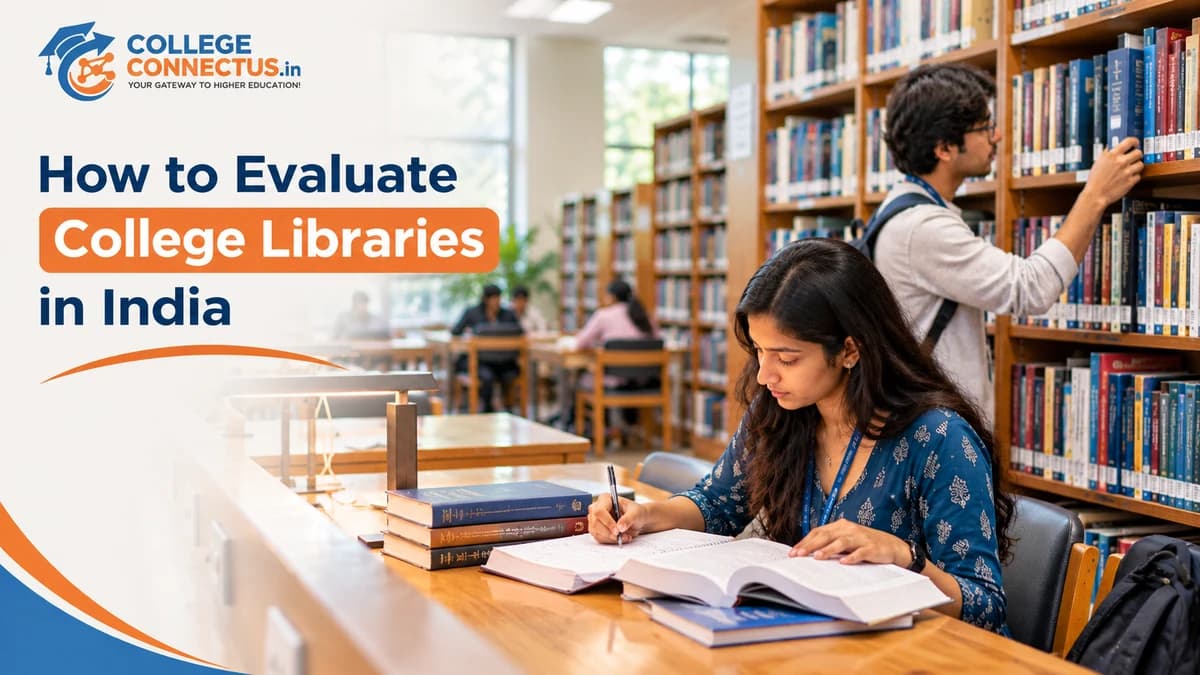
When choosing a college, students often compare tuition fees, placements, course options, campus facilities and rankings. However, one important academic resource can receive less attention than it deserves: the college library.
A well-supported library can help students understand difficult subjects, prepare for examinations, complete assignments, conduct research and develop independent learning habits. Depending on the institution, it may provide printed books, academic journals, digital databases, reference materials, quiet study areas and research assistance.
However, the quality of a college library cannot be judged simply by its size or the number of books displayed on its shelves. Students should investigate whether the resources are relevant to their courses, available when needed, regularly maintained and accessible to eligible learners.
This guide explains how to evaluate college libraries in India before taking admission, including what to inspect during a campus visit, which questions to ask and how to compare facilities across institutions.
A college library is more than a room containing books. It can be an important part of the academic environment, supporting both structured coursework and independent learning.
Students may use library resources to:
Understand concepts beyond classroom explanations.
Consult textbooks and reference materials.
Prepare assignments, presentations and examinations.
Access academic journals and research publications.
Develop research and information-literacy skills.
Study in a quieter environment than a hostel or shared accommodation.
Explore subjects beyond their prescribed syllabus.
Find credible sources for projects and dissertations.
The value of these facilities depends on the student's course, learning preferences and academic requirements.
For example, an engineering student may need technical reference books, standards and access to relevant digital publications. A management student may benefit from business databases, case studies and market research resources. A research student may need specialist journals and assistance with academic literature searches.
The most useful college library is one that provides relevant resources and practical access to them—not necessarily the one with the largest building.
Printed books remain useful for understanding foundational concepts, consulting detailed explanations and studying without depending entirely on an internet connection.
When evaluating a library, begin by examining the resources available for your intended programme.
Ask whether the library maintains the textbooks recommended by your department.
Investigate:
Whether the prescribed titles are available.
Whether multiple copies are provided for popular courses.
Whether books are available for different semesters.
Whether older editions are being used where newer editions are necessary.
Whether students can reserve books that are currently issued.
Whether essential books can be borrowed or consulted only inside the library.
A library may list a title in its catalogue without having an available copy. Where possible, ask students whether they can regularly access the materials they need.
Depending on the course, useful additional resources may include:
Reference books and encyclopaedias.
Subject dictionaries and technical manuals.
Competitive examination preparation materials.
Research methodology books.
Case studies and professional publications.
Newspapers and relevant magazines.
Dissertations, theses and previous research projects, where access is permitted.
The appropriate collection varies by institution and programme. A college offering specialist postgraduate courses should be assessed against those courses' academic requirements rather than a generic book-count target.
A collection may contain many books but still lack important recent publications.
Ask how the library identifies new requirements, purchases updated editions and responds to faculty or student requests.
For technical, scientific and professional subjects, the currency of resources can be particularly important. At the same time, older editions of foundational works may remain useful when their content is still appropriate.
Many colleges provide access to electronic books, journals, research databases and digital learning platforms.
These resources can be especially useful when students need specialist material that is unavailable in printed form.
However, digital library access differs considerably between institutions. Some offer broad institutional subscriptions, while others provide a smaller selection of resources.
Ask whether the college provides access to:
Electronic books.
Academic journals.
Subject-specific research databases.
Dissertations and research repositories.
Digital reference materials.
Institutional research publications.
Online learning resources relevant to the programme.
Do not assume that every resource advertised on a library webpage is included in the college's subscription. Some platforms may be publicly accessible, while others require an institutional account or separate payment.
Ask the librarian which resources are available to students in your intended department.
Digital resources are useful only when eligible students can access them.
Find out:
Whether access is available on campus, remotely or both.
Whether students need an institutional login.
Whether access is restricted to particular departments.
Whether there are limits on downloads or simultaneous users.
Whether subscriptions remain active throughout the academic year.
Whether support is available when students experience login problems.
Remote access can be particularly helpful for students who live in hostels, commute or need to work outside regular library hours.
Students may not immediately know how to search academic databases, identify reliable publications or access full-text research papers.
A library that offers introductory sessions or research guidance can help students use its resources more effectively.
To understand how academic facilities fit into the wider campus environment, read How to Evaluate College Infrastructure and Facilities in India.
A library's physical environment can influence how comfortably students study, read and work on assignments.
If you visit the campus, look beyond the entrance and reception area. Ask whether you can inspect the main reading areas and facilities available to students.
Check whether the library has sufficient seating during busy academic periods.
Ask current students:
Is it difficult to find a seat before examinations?
Are individual study spaces available?
Are group study areas provided separately?
Can students reserve seats or rooms?
Are the reading areas overcrowded at peak times?
The number of seats alone does not determine quality. Their availability, arrangement and suitability for different learning activities also matter.
Observe whether the reading areas have suitable lighting, ventilation and comfortable seating.
Check whether desks provide enough space for books, notebooks and laptops. Consider whether the environment supports extended study sessions without unnecessary distractions.
Also inspect basic cleanliness and the general condition of furniture.
Some students prefer quiet individual study, while others need spaces for group discussions and project work.
A well-organised library may separate silent reading areas from collaborative study zones. If group rooms are provided, ask whether they are available to students and whether advance booking is necessary.
Consider whether the library is accessible to students with different mobility and learning needs.
Depending on the campus, relevant features may include accessible entrances, lifts, suitable seating, assistive technology and alternative formats for learning materials.
Ask about the arrangements available rather than assuming that a modern-looking building meets every student's requirements.
Opening hours can significantly affect how useful a library is for students with different schedules.
A library that closes before the end of a student's classes may be less convenient than one offering suitable evening or weekend access.
Ask about:
Regular weekday opening hours.
Weekend and public-holiday schedules.
Extended hours during examinations.
Access during semester breaks.
Rules for students living in hostels.
Entry requirements outside regular class hours.
Do not rely only on a general statement that the library is open throughout the day. Confirm the current schedule with the institution.
Before admission, investigate the basic lending rules.
Questions worth asking include:
How many books can students borrow at once?
What is the standard loan period?
Can books be renewed?
Can students reserve unavailable books?
Are there late-return penalties?
Are reference books excluded from borrowing?
Are postgraduate students and research scholars subject to different rules?
These policies can influence how easily students obtain resources during busy periods.
Students should be able to understand how to register, search the catalogue, borrow books, renew loans and return materials.
A clearly communicated system reduces confusion and helps students use library services independently.
A library may offer valuable digital resources but provide limited access to the equipment needed to use them.
If you expect to rely on campus computers, investigate their availability and condition.
Ask whether the library has computers for academic research, document preparation and accessing subscribed resources.
Find out whether students can use them without advance booking, whether access is time-limited and whether specialist software is available where relevant.
For technical programmes, check whether the required software is provided in the library or through separate department laboratories.
Investigate whether the library offers reliable internet access and whether students can connect their own devices.
Consider:
Wi-Fi availability.
Connectivity in different study areas.
Access restrictions.
Support for technical problems.
Whether digital subscriptions work on campus networks.
If digital research is a major part of your intended course, connectivity is worth evaluating during a campus visit.
Some libraries provide printing, scanning or photocopying facilities. Others rely on separate campus services.
Ask about availability, charges, operating hours and any restrictions on copying copyrighted material.
These services are convenient but should not be treated as essential features of every college library.
For students completing dissertations, research projects or advanced coursework, library support may extend beyond access to books.
Research support can include assistance with identifying relevant publications, searching databases, organising references and understanding how to evaluate sources.
Find out whether students can approach library staff for help with:
Searching the catalogue.
Finding subject-specific resources.
Accessing subscribed databases.
Locating research publications.
Using citation and referencing tools.
Understanding plagiarism and academic integrity.
Finding institutional theses or dissertations, where permitted.
The depth of assistance may vary depending on the size and purpose of the institution.
Postgraduate and research students may need more specialised resources than undergraduate students.
Depending on the programme, investigate access to subject databases, technical standards, research repositories, archival materials or specialist reference collections.
If the college has active research departments, ask whether students can access relevant library resources and whether additional permissions are required.
Library staff can help students locate and use resources, but they may not provide subject-specific academic supervision.
Ask how library services coordinate with faculty members and research supervisors where relevant.
A library should be evaluated in relation to the academic programme you plan to study.
A large general collection may be useful, but specialist courses may require additional resources that are not immediately visible during a short campus tour.
Programme | Resources worth checking | Questions to ask |
|---|---|---|
Engineering | Technical textbooks, standards, reference manuals and relevant digital publications | Are materials available for the department's core subjects and practical modules? |
Computer Applications and IT | Programming books, software documentation, computing resources and technical publications | Can students access relevant resources for projects and current coursework? |
Management | Business case studies, industry publications, research journals and market information | Are resources available for finance, marketing, operations and other relevant specialisations? |
Science | Subject textbooks, laboratory references and research publications | Are the resources suitable for the course's practical and research components? |
Humanities and Social Sciences | Scholarly books, journals, primary sources and reference collections | Is there sufficient depth for reading-intensive coursework and research? |
Law | Legal reference books, legislation, case law and relevant legal databases | Which legal resources are available, and what access restrictions apply? |
Healthcare programmes | Medical or healthcare textbooks, subject-specific references and applicable research resources | Are the resources appropriate for the curriculum and relevant professional requirements? |
Research programmes | Specialist journals, theses, research databases and citation resources | Can students access the literature and databases required for their research? |
This table is a guide, not a universal standard. Resource requirements depend on the course structure, institution and applicable academic or regulatory expectations.
If you are comparing engineering colleges, you can also read How to Choose the Best Engineering College in India.
A library may appear impressive during a campus tour, but current students can explain how well it functions during a normal academic week.
Try to speak with students from your intended department and, if possible, students in different years of study.
Ask questions such as:
Can you usually find the books required for assignments?
Are library seats available during examinations?
Do digital resources work reliably?
Are staff members helpful when students need assistance?
Are the opening hours suitable for your academic schedule?
Are group study facilities available?
Are borrowing and renewal procedures straightforward?
Which library services do students use most often?
What improvements would students like to see?
Specific questions tend to produce more useful answers than simply asking whether the library is good.
One student may prefer a quiet library, while another may place more importance on group study facilities or longer opening hours.
Look for repeated themes rather than relying on one comment.
You can also apply the principles in How to Read College Reviews in India and Spot Misleading Claims when assessing online feedback.
Student opinions can provide useful context, but confirm important claims through direct observation or official information where possible.
Some colleges provide additional learning resources through departments, research centres, computer laboratories and online learning systems.
These resources may complement the library's physical and digital collection.
During your research, investigate whether students can access:
Department reading rooms.
Digital repositories.
Research centres.
Subject-specific laboratories.
Online academic learning platforms.
Faculty-recommended reading lists.
Study support sessions.
Research seminars or academic workshops.
Access rules may vary by department, academic year or programme. Confirm whether the facilities are available to students in your intended course.
Also distinguish between facilities that are available in principle and those students can regularly use.
A college may have a specialised resource but restrict access to certain programmes or approved research activities.
Library quality also depends on how well resources are organised, maintained and updated.
A large collection is less useful if students cannot find relevant books or if catalogue information is inaccurate.
Ask whether the library provides a searchable catalogue and whether it shows book availability.
If possible, search for a few titles relevant to your intended course.
Observe whether the catalogue identifies the book's location, edition and borrowing status.
A well-maintained catalogue can save students time and help them locate resources independently.
Ask how the library collects feedback from faculty and students about missing books or new resource requirements.
Some institutions may have formal book-request systems, while others may handle requests through departments.
The important question is whether the institution has a clear process for identifying and addressing resource gaps.
During a campus visit, observe whether books are arranged systematically, reading areas are maintained and library rules are clearly displayed.
Also ask how students can report missing materials, damaged books or technical problems.
These details may appear minor, but they affect the everyday usability of the facility.
Avoid these common errors when comparing colleges.
A spacious building does not guarantee relevant books, effective services or convenient access.
Better approach: Evaluate the resources, facilities and services students can actually use.
A catalogue entry or website listing may not mean the item is currently available for borrowing.
Better approach: Check availability and ask how students reserve books.
A physical collection may be adequate for basic coursework but insufficient for students who need specialist research material.
Better approach: Ask about relevant databases, digital books, remote access and subscription arrangements.
A library may have good facilities but limited access outside regular class hours.
Better approach: Compare operating schedules with your likely study routine.
Photographs show what a facility looks like at a particular time, not how accessible or useful it is throughout the academic year.
Better approach: Speak with students, inspect the facilities and ask specific questions.
A resource that is valuable for one programme may have limited relevance to another.
Better approach: Compare the library's collection with your actual syllabus and academic goals.
If you are comparing multiple institutions, use the same checklist for every college.
Rate each category from 1 to 5:
1: Very limited evidence.
2: Below expectations.
3: Acceptable.
4: Strong.
5: Strong, relevant and well-supported.
Evaluation category | Score out of 5 | Evidence to collect |
|---|---|---|
Course-specific books | ___ | Catalogue, prescribed reading lists and available copies |
Digital resources | ___ | Database list, e-book access and subscription details |
Reading spaces | ___ | Campus visit and student feedback |
Opening hours | ___ | Published schedule and examination-period arrangements |
Borrowing policies | ___ | Lending, renewal and reservation rules |
Computer and internet facilities | ___ | Available equipment and access arrangements |
Research support | ___ | Library services and guidance available to students |
Accessibility | ___ | Physical access and relevant support services |
Resource maintenance | ___ | Catalogue quality, collection updates and facility condition |
Student satisfaction | ___ | Feedback from multiple current students |
Important: This scorecard is a personal comparison tool, not an official college rating. Score only what you can reasonably verify. If information is unavailable, record it as "Not verified" rather than assuming the facility is poor.
You can adjust the categories according to your course. For example, research databases may deserve greater importance for a research-intensive programme, while extended reading hours may be more important to a student who plans to study on campus after classes.
Combine the scorecard with your evaluation of faculty, infrastructure, fees and academic suitability before making a decision.
If you have an opportunity to visit a college, prepare a short list of questions in advance.
About books and resources
Does the library stock the prescribed textbooks for my programme?
Can students request additional books?
Are specialist reference materials available?
About digital access
Which electronic resources are included in student access?
Can students use these resources off campus?
Are any additional charges required?
About study facilities
What are the normal and examination-period opening hours?
Are quiet reading areas and group study spaces available?
Are computer facilities available to all eligible students?
About services
What are the borrowing and renewal rules?
Can students receive help with academic research?
Are library orientation sessions organised for new students?
About access
Are there programme-specific restrictions?
What accessibility arrangements are available?
Are the resources available throughout the academic year?
Record the answers for each institution. This will make it easier to compare colleges after visiting several campuses.
Review the library's book collection, digital resources, opening hours, reading spaces, borrowing policies and research support. Check official information, visit the campus where possible and ask current students about their experiences.
Useful facilities may include course-relevant books, reference materials, suitable study spaces, a searchable catalogue and access to relevant digital resources. Additional services depend on the institution, programme and student requirements.
Digital libraries can provide convenient access to electronic books, journals and research databases. They are particularly useful when students need specialist publications or study resources outside regular library hours. Their value depends on the resources offered and the access arrangements.
Check whether the library stocks the prescribed reading materials for your course, whether sufficient copies are available and whether students can obtain books when needed. A total book count alone does not establish the adequacy of a collection.
Yes. Depending on its facilities, a library may provide access to research publications, academic databases, reference materials and guidance on finding credible sources. The extent of support varies between institutions.
No. The library is one part of the academic environment. Evaluate it alongside teaching quality, curriculum, recognition, practical facilities, fees, student support and your personal priorities.
Evaluating a college library can help you understand how well an institution supports independent learning, academic research and everyday coursework.
Look beyond the building and book count. Investigate the relevance of the collection, availability of digital resources, study spaces, opening hours, borrowing rules and research support. Speak with current students and verify important details before relying on promotional claims.
Most importantly, assess the library against the needs of your intended programme and your own learning preferences.
A useful college library is not simply a place to borrow books. It is an academic resource that should help students access information, develop research skills and learn more independently.
When comparing colleges, consider the library as part of the wider learning environment and use evidence to make an informed admission decision.
Explore College Connect Us to research colleges, compare academic facilities and build a shortlist that matches your educational goals.
Explore expert articles, admission guides, career tips, education news, exam preparation, and everything you need to make informed academic decisions.