
College Connect
Preparing your experience...
Preparing your experience...

Need help? 👋
We're here to help you
Looking for the right college, course or admission guidance? Choose an option below.
A college hostel can significantly influence your student experience. Learn how to evaluate accommodation, food, safety, hygiene, facilities and hostel expenses before making your decision.
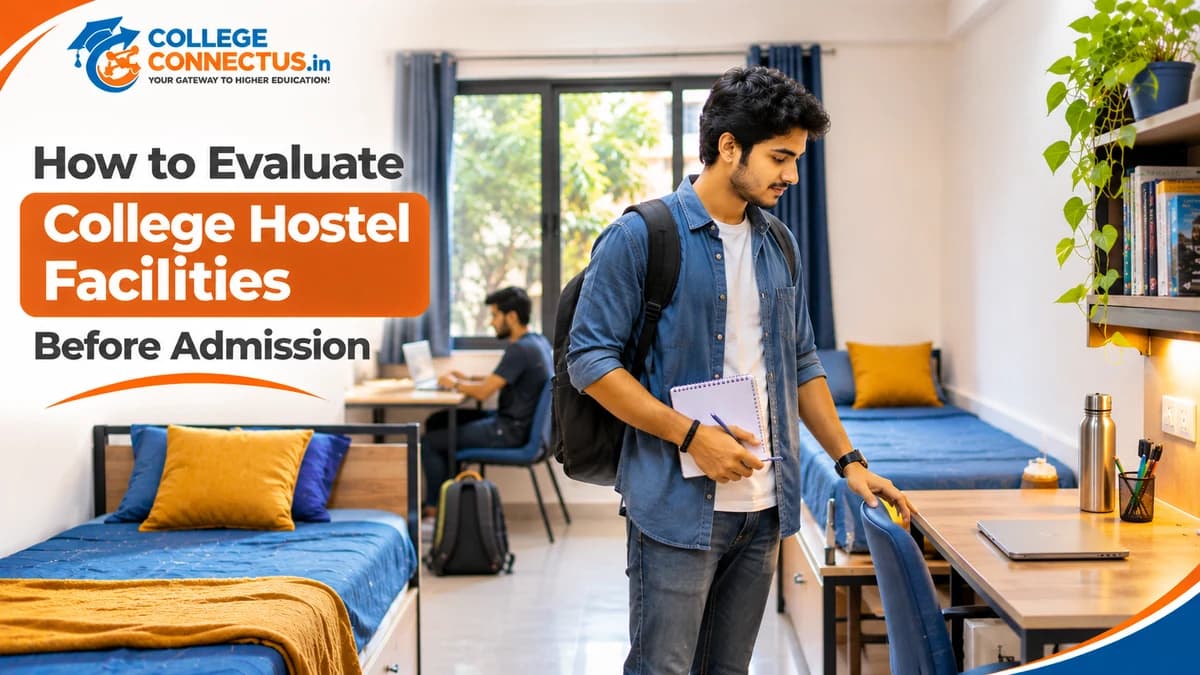
Choosing a college involves more than comparing courses, fees and placement opportunities. If you plan to live on campus, the quality of hostel facilities should also be an important part of your decision.
For many students, a college hostel becomes their home for several years. It is where they study, rest, interact with classmates and develop independence. A comfortable and well-managed hostel can make daily college life easier, while unsuitable accommodation may create unnecessary difficulties.
However, hostel facilities differ considerably between colleges. Some institutions offer furnished rooms, dining facilities, recreation areas and dedicated study spaces. Others provide basic accommodation with limited amenities.
That is why students should evaluate hostel facilities before confirming admission or paying accommodation fees.
This guide explains how to evaluate college hostel facilities in India, what questions to ask during a campus visit and which factors deserve attention before selecting student accommodation.
Before comparing facilities, understand what type of accommodation the institution provides.
On-campus hostels are located within the college or university premises.
They may offer convenient access to:
Academic buildings.
Libraries.
Laboratories.
Sports facilities.
Dining areas.
Administrative offices.
Living on campus can reduce daily commuting requirements, depending on the location of the hostel and academic buildings.
Some colleges arrange accommodation outside their main campus.
These facilities may be managed by the institution, a third-party provider or a private accommodation operator.
Before choosing an off-campus hostel, check transportation arrangements, distance from the college, security measures and additional expenses.
Students may also consider privately operated hostels or paying guest accommodation.
These options can provide flexibility, but their facilities, management standards, agreements and pricing vary.
Check the ownership or management details and understand the accommodation terms before making any payment.
The room is one of the most important aspects of hostel accommodation.
Students should examine the actual room rather than relying only on photographs or promotional information.
Check how many students share each room.
A single-sharing room provides more individual space, while double-sharing or multiple-sharing accommodation may reduce the cost.
Consider:
Number of occupants.
Available floor space.
Bed arrangements.
Personal storage.
Study space.
Ventilation.
Natural lighting.
Do not assume that all rooms within a hostel have identical facilities.
Ask whether the hostel provides:
Bed and mattress.
Study table.
Chair.
Wardrobe or cupboard.
Bookshelves.
Basic lighting.
Confirm whether students need to arrange any additional furniture or bedding themselves.
A room should have adequate ventilation and sufficient lighting for everyday activities.
Check windows, fans, lighting arrangements and general room conditions.
If possible, inspect the room during the daytime.
Look for signs of regular maintenance.
Check whether doors, windows, electrical fittings and furniture are in usable condition.
Ask how students can report maintenance issues and how quickly complaints are normally addressed.
Clean and accessible sanitation facilities are essential for comfortable hostel living.
The arrangement may differ between hostels.
Some provide attached bathrooms, while others have shared bathroom facilities.
During your inspection, check:
Number of bathrooms relative to occupants.
Water availability.
Cleanliness.
Drainage.
Ventilation.
Bathroom lighting.
Cleaning schedules.
Maintenance arrangements.
Ask whether hot water is available and whether there are restrictions on its usage.
Also understand how students can report plumbing problems or sanitation-related complaints.
Do not evaluate hygiene based only on a freshly cleaned room during a campus visit. Ask about the regular cleaning schedule and maintenance process.
Food is another important consideration when selecting student accommodation.
Students may depend on hostel dining facilities for most of their daily meals.
Before choosing a hostel, understand how the mess or dining system operates.
Ask whether the hostel provides:
Breakfast.
Lunch.
Evening snacks.
Dinner.
Drinking water.
Special arrangements during holidays.
Meal schedules and availability may differ between institutions.
If possible, visit the dining area during a regular meal period.
Observe:
Cleanliness of dining tables.
Food storage arrangements.
Kitchen hygiene.
Drinking water facilities.
Waste disposal.
Food serving practices.
Ask current residents about their everyday dining experience.
Some colleges include food charges in the hostel fee, while others collect mess charges separately.
Check:
Monthly mess charges.
Refund conditions.
Meal subscription rules.
Additional charges.
Whether students can opt out of the mess facility.
Do not compare hostel fees without understanding which services are included.
Safety should be one of your highest priorities when evaluating student accommodation.
Different institutions follow different security arrangements. Students should understand the actual procedures rather than assuming that every hostel provides the same level of protection.
Ask how the hostel manages student entry and exit.
Check whether the institution has:
Visitor registration.
Entry records.
Security personnel.
Hostel access cards or identity verification.
Defined visiting hours.
Procedures for reporting unauthorised entry.
Ask which common areas are monitored and how security concerns are handled.
Understand the institution's privacy policies and where surveillance systems are installed.
Find out whether the hostel has:
Emergency contact numbers.
Fire safety equipment.
Emergency evacuation procedures.
Access to medical assistance.
A designated hostel warden.
A complaint reporting mechanism.
A hostel warden or designated administrator helps manage routine student concerns.
Ask who is responsible for handling accommodation complaints, emergencies and disciplinary matters.
For additional guidance, students should also understand the campus-level support arrangements described in our guide on evaluating college student support services in India.
Internet access has become an important requirement for many college students.
Students may use online platforms for assignments, research, digital learning and communication.
Before selecting a hostel, check whether Wi-Fi or another internet facility is available.
Ask:
Is Wi-Fi included in the hostel fee?
Is it available in all rooms or only common areas?
Are there usage limits?
Are there restrictions on access?
Is technical support available?
If possible, check connectivity from the actual room you may occupy.
Some hostels provide dedicated study spaces.
Check whether the facility includes:
Study tables.
Comfortable seating.
Sufficient lighting.
Electrical charging points.
Quiet study arrangements.
Defined operating hours.
Ask whether backup electricity is available during power interruptions.
Understand whether backup power covers only common areas or also individual rooms.
The availability and scope of backup facilities should be confirmed rather than assumed.
The advertised hostel fee may not represent the complete cost of accommodation.
Different colleges follow different fee structures.
Some combine accommodation and food charges, while others collect separate payments.
Create a detailed comparison before making your decision.
Expense | What to Verify |
|---|---|
Hostel accommodation | Annual or semester room charges |
Security deposit | Refundable amount and conditions |
Mess charges | Monthly or annual food expenses |
Electricity | Included or separately charged |
Internet | Included or additional payment |
Laundry | Free, paid or self-service |
Maintenance | Included or separately collected |
Transportation | Additional travel expenses, if applicable |
Before paying, ask for written information about:
Hostel cancellation.
Security deposit refunds.
Fee adjustment.
Withdrawal conditions.
Refund timelines.
Charges applicable after joining.
Keep payment receipts and copies of official hostel documents.
You can also read our guide on how to choose a college based on your budget in India to understand how accommodation expenses fit into your overall education budget.
Every hostel may have its own rules regarding student conduct and accommodation management.
Read the rules before accepting a hostel allotment.
Important areas to review include:
Check whether the hostel has fixed entry and exit timings.
Understand the procedure for late entry, overnight absence and approved travel.
Ask whether visitors are allowed and which areas they can access.
Check the rules for parents, guardians and other guests.
Some hostels require students to submit leave requests before travelling.
Understand the approval procedure and whether hostel attendance is maintained.
Ask which electrical appliances are permitted in rooms.
Follow fire safety rules and avoid using unauthorised equipment.
Read the rules concerning prohibited activities, misconduct, damage to property and complaint handling.
A clear understanding of hostel policies can prevent misunderstandings later.
Additional facilities can make everyday hostel life more convenient.
However, students should distinguish between essential facilities and optional amenities.
Check whether the hostel provides:
Washing machines.
Paid laundry services.
Drying areas.
Ironing facilities.
Designated laundry schedules.
Ask whether these services are included in the hostel charges.
Some hostels provide common rooms, indoor games or outdoor recreational spaces.
These facilities may help students relax and interact with other residents.
Check their availability and operating rules.
Understand what medical assistance is available in case of illness or emergencies.
Ask whether the hostel has access to a first-aid facility, medical room, nearby healthcare providers or emergency transportation.
Check the availability and maintenance of drinking water facilities.
Ask how water quality is monitored and how students can report problems.
Photographs and online descriptions cannot always provide a complete picture of hostel conditions.
Whenever possible, visit the accommodation before confirming your choice.
During the visit:
Inspect the actual room or a representative room.
Check bathrooms and common areas.
Visit the dining facility.
Observe cleanliness and maintenance.
Ask about security arrangements.
Check internet connectivity.
Review the hostel fee structure.
Read the accommodation rules.
If you cannot visit personally, request a live video tour or ask the college for recent photographs and written facility details.
Do not make a payment based only on verbal promises.
Current residents can provide practical information about everyday hostel life.
Their experiences may help you understand how facilities work outside the formal campus tour.
Consider asking:
Are rooms maintained regularly?
Is drinking water consistently available?
Is the food arrangement satisfactory?
Are complaints addressed?
Is the internet reliable?
Are hostel rules communicated clearly?
Are additional charges collected?
Is the hostel environment suitable for studying?
Try to speak with more than one resident.
Individual experiences can differ, so look for recurring observations rather than relying on a single opinion.
You can also refer to our guide on how to read college reviews in India and spot misleading claims.
Students sometimes focus on hostel appearance without checking the practical details.
Avoid these mistakes.
Promotional photographs may not represent every room or common area.
Inspect the actual facilities wherever possible.
A low advertised hostel fee may exclude mess, laundry, electricity or other services.
Calculate the complete cost before comparing options.
Entry timings, visitor policies and leave procedures may affect everyday life.
Read the rules before accepting accommodation.
Speak with current residents to understand actual maintenance, food and management practices.
Ask about security personnel, emergency procedures, wardens and complaint mechanisms.
Verify the hostel allotment, fee details and refund conditions through official documents.
Avoid transferring money to unverified individuals or accounts.
Use this checklist while comparing hostel facilities at different colleges.
Evaluation Area | What to Check |
|---|---|
Room facilities | Size, occupancy, furniture and ventilation |
Sanitation | Bathrooms, water and cleaning arrangements |
Food | Mess quality, meal schedule and charges |
Safety | Security, visitor rules and emergency procedures |
Internet | Wi-Fi availability and connectivity |
Study facilities | Reading areas and quiet spaces |
Electricity | Power supply and backup |
Fees | Accommodation, mess and additional charges |
Maintenance | Complaint handling and repair process |
Rules | Entry timings, leave and visitor policies |
Medical support | First aid and emergency arrangements |
Resident feedback | Actual student experiences |
You can use this checklist to prepare a comparison sheet for every hostel you visit.
If you have shortlisted multiple colleges, evaluate their accommodation facilities using the same criteria.
For example:
Comparison Factor | College A | College B | College C |
|---|---|---|---|
Room occupancy | Verify | Verify | Verify |
Food arrangement | Verify | Verify | Verify |
Security | Verify | Verify | Verify |
Internet | Verify | Verify | Verify |
Study area | Verify | Verify | Verify |
Medical support | Verify | Verify | Verify |
Total annual cost | Calculate | Calculate | Calculate |
Refund policy | Review | Review | Review |
Do not give every factor equal importance automatically.
For some students, safety and affordability may be the highest priorities. Others may place more importance on study facilities, food arrangements or proximity to academic buildings.
Choose according to your actual needs.
Choosing the right college hostel is an important part of planning your higher education journey.
A good accommodation decision should consider more than room appearance or advertised amenities. Students should examine room conditions, sanitation, food, safety, internet connectivity, maintenance, hostel rules and the complete cost of living.
Visit the hostel whenever possible, speak with current residents and request written information about fees and policies before making a payment.
Remember that the best hostel is not necessarily the one with the most facilities. It is the one that offers suitable accommodation, reliable management and a living environment that supports your academic and personal needs.
Explore College Connect Us for more practical information about college selection, student accommodation, campus facilities and higher education in India.
Important facilities may include suitable rooms, clean bathrooms, drinking water, food arrangements, security, electricity, study spaces and maintenance support. Actual facilities differ between institutions.
Inspect room conditions, occupancy, sanitation, food, security, internet access, fees, refund rules and hostel regulations. Speak with current residents if possible.
Not always. Many institutions charge hostel accommodation and mess fees separately. Check the official fee structure to understand the complete cost.
Ask about security personnel, entry procedures, visitor registration, hostel wardens, emergency contacts and fire safety arrangements.
On-campus accommodation may provide convenient access to academic facilities. Off-campus accommodation may offer different pricing or arrangements. Compare distance, safety, transportation and total expenses.
Ask about room maintenance, food quality, water availability, internet connectivity, complaint handling, additional charges and the everyday hostel environment.
Refund policies depend on the institution and the terms of allotment. Read the official cancellation and refund rules before paying.
Reliable internet can support research, online learning, assignment submissions and academic communication. Check whether Wi-Fi is available and whether any restrictions apply.
A college hostel is generally operated or arranged by an educational institution, while PG accommodation is usually privately managed. Rules, services, fees and management arrangements can differ.
Apply according to the institution's official hostel admission schedule. Some colleges allot rooms alongside academic admissions, while others follow a separate process. Confirm availability and deadlines directly with the institution.
Explore expert articles, admission guides, career tips, education news, exam preparation, and everything you need to make informed academic decisions.