
College Connect
Preparing your experience...
Preparing your experience...

Need help? 👋
We're here to help you
Looking for the right college, course or admission guidance? Choose an option below.
Want to withdraw from a college and request a fee refund? This guide explains how to review the applicable refund policy, submit an admission cancellation request, prepare supporting documents, track your application and follow up on delays. It also includes a sample refund-request email and explains why students should verify the rules that apply to their institution and admission session.
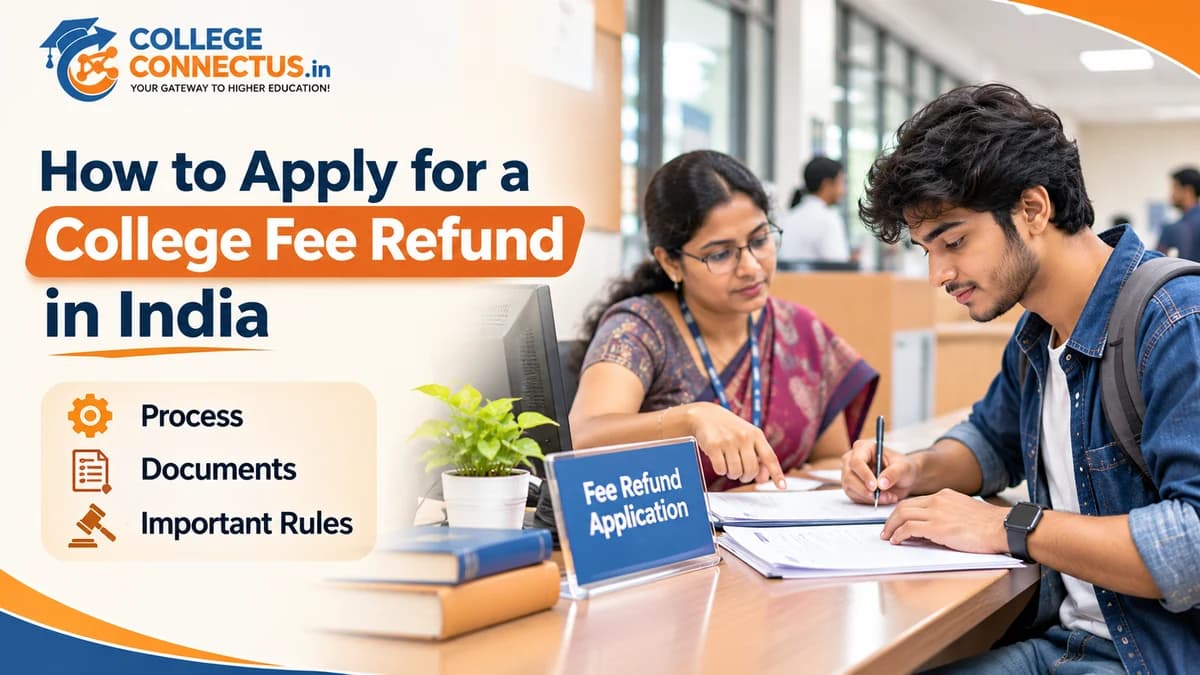
Paying a college admission fee is an important financial commitment for students and their families. However, circumstances can change. You might receive an offer from another institution, decide to pursue a different course, encounter an unexpected financial difficulty or choose not to continue with your admission.
In such situations, you may need to cancel your admission and apply for a college fee refund.
The process usually involves submitting a formal withdrawal request, checking the applicable refund policy, providing supporting documents and following up with the institution's admission or accounts department.
However, the amount you can receive and the time allowed to request a refund depend on the rules applicable to your institution and admission session. Do not assume that every college follows identical conditions.
This guide explains how to apply for a college fee refund in India, what documents you may need, how to write a refund request and what to do if your application remains unresolved.
Before submitting a refund application, locate the official fee refund policy applicable to your admission.
Colleges and universities may publish refund conditions in their admission prospectus, fee policy, admission portal or official notifications. The applicable rules may also depend on the regulator, university, course and admission route.
Review the following details:
The deadline for withdrawing from the course.
The procedure for cancelling admission.
The date used to determine refund eligibility.
The percentage or amount that may be refunded.
Any permitted processing charges or deductions.
Whether security deposits are treated separately.
The expected refund-processing timeline.
Any additional conditions applicable to your course or institution.
A refund policy may calculate eligibility based on when the institution receives your withdrawal notice, rather than when you begin preparing the application.
For this reason, submit your request through the prescribed channel as soon as you have made your decision.
Keep proof of submission, such as an acknowledgement, email confirmation or application reference number.
The University Grants Commission (UGC) has issued fee-refund guidance for higher education institutions within its applicable scope. The policy has included provisions based on the timing of a student's withdrawal request.
However, specific deadlines and refund conditions can change between academic sessions or through later notifications.
Students applying to professional programmes, institutions regulated by other authorities, counselling-based admissions or specialised courses should also check the applicable rules for their admission route.
Important: Do not rely on an old refund-policy screenshot or a percentage copied from another college. Verify the latest official notification and your institution's published policy before calculating the expected refund.
Before applying, prepare a record of every payment made to the institution.
Your total payment may include several components, such as:
Admission or registration fee.
Tuition fee.
Semester or annual fee.
Caution money or security deposit.
Hostel or accommodation fee.
Examination fee.
Laboratory or other programme-related charges.
Other fees listed in the official fee structure.
Not every component is necessarily refundable under the same conditions.
For example, an institution may treat a security deposit differently from a registration charge. Hostel fees may also be governed by separate rules.
Create a simple payment record:
Payment detail | Information to record |
|---|---|
Payment date | Date on which the transaction was made |
Amount paid | Amount shown on the receipt |
Fee component | Tuition, registration, deposit or another charge |
Payment method | Official portal, bank transfer or another authorised method |
Transaction reference | Payment or transaction ID |
Receipt | Location of the saved receipt |
Refund status | Pending, approved, processed or another confirmed status |
This record will help you explain your request clearly and identify any discrepancy in the amount returned.
The refund process usually begins with an official admission withdrawal or cancellation request.
Some institutions provide an online cancellation option. Others require a written application submitted to the admission office, registrar or another designated department.
Follow the method stated in your institution's instructions.
Open the institution's official website.
Sign in to the admission portal using your registered credentials.
Locate the admission withdrawal or cancellation option.
Read the instructions and consequences carefully.
Complete the prescribed form.
Upload supporting documents if requested.
Submit the application.
Save the acknowledgement or application number.
Before confirming the cancellation, check whether the action is reversible and whether it affects participation in any ongoing counselling process.
Prepare a clear request containing your student details, programme information, admission date, payment details and reason for withdrawal, if required.
Address it to the department specified in the official policy.
Submit it through the accepted channel, such as the official email address, student portal or college office.
If you submit the application in person, request an acknowledgement. If you send it by email, retain a copy of the sent message and any reply.
Do not assume that informing a teacher, counsellor or classmate is sufficient to cancel your admission. Make sure the request reaches the department authorised to process it.
The documents required can differ between institutions. Check the official refund instructions before submitting your application.
Commonly requested documents may include:
Admission offer letter or admission confirmation.
Student application or registration number.
Fee-payment receipts.
Refund or admission cancellation application.
Government-issued identity proof, where required.
Student identification card, if already issued.
Bank account details for the refund.
Transaction reference numbers.
Hostel cancellation acknowledgement, if applicable.
No-dues certificate, where required under the applicable procedure.
Any additional declaration specified by the institution.
If the institution refunds money by bank transfer, confirm the accepted account details and required supporting documents.
The institution may have specific instructions about whether the refund must go to the original payment source or another verified account.
Do not assume that a different account can automatically be used.
Never share your banking password, one-time password or payment PIN as part of a refund request.
Create a folder containing your admission records, receipts, cancellation request, supporting documents and communication with the institution.
Use clear filenames so you can find each document easily.
For example:
Admission_Confirmation.pdf
College_Fee_Receipt.pdf
Fee_Refund_Application.pdf
Withdrawal_Acknowledgement.pdf
Refund_Communication.pdf
A complete record makes it easier to respond if the accounts department asks for clarification.
Your application should be polite, specific and easy to process.
Include the following information:
Your full name.
Application or registration number.
Course and department.
Admission date, if relevant.
Total amount paid.
Payment dates or transaction references.
Your request to withdraw or cancel admission.
Your request for a refund under the applicable policy.
A list of supporting documents.
Your contact details.
You do not need to include unnecessary personal information.
If the institution requires a prescribed form, complete that form rather than relying only on an email.
Subject: Request for Admission Cancellation and Fee Refund — [Application Number]
Dear Admissions Team,
I am writing to request cancellation of my admission to [Course Name] at [College Name] and a refund of the eligible fees paid.
My details are as follows:
Student Name: [Full Name]
Application/Registration Number: [Number]
Course: [Course Name]
Admission Date: [Date, if applicable]
Total Amount Paid: ₹[Amount]
Payment Reference: [Transaction ID, if applicable]
I request that you process my admission withdrawal and assess my refund eligibility under the applicable fee refund policy.
Please let me know if any additional documents or formalities are required. I would also appreciate written confirmation of my cancellation request and an update on the expected refund-processing timeline.
I have attached the relevant admission and payment documents for reference.
Thank you for your assistance.
Regards,
[Full Name]
[Registered Email Address]
[Contact Number]
Use the correct official email address and replace all placeholders before sending. If the institution provides a dedicated refund form, submit it as instructed.
Timing can be important when applying for a college fee refund.
The applicable policy may distinguish between requests received before the last notified admission date and requests received after it.
For this reason, do not wait until the end of the admission period to begin the process.
Follow these steps:
Identify the officially notified last date of admission.
Check the withdrawal and refund rules for your admission session.
Confirm the department or portal that must receive the request.
Submit the request as early as possible.
Save evidence showing when it was submitted or received.
Follow any additional cancellation instructions.
If you have already missed a stated deadline, do not assume that a refund is automatically impossible. Review the applicable policy and contact the institution to ask what options remain available.
The institution should assess your request under the rules applicable to your case.
After receiving your application, the institution may assess your refund eligibility under its applicable policy.
The amount returned may depend on factors such as:
The date the withdrawal request was received.
The formally notified admission deadline.
The type of fee paid.
The institution's applicable refund policy.
Any permitted deductions.
Separate conditions for accommodation or other services.
A tuition payment, registration charge, refundable deposit and hostel payment may be governed by different conditions.
Request a written breakdown if the institution communicates a refund amount that you do not understand.
The breakdown should help you identify:
The amount paid.
The amount approved for refund.
Any deductions.
The reason for each deduction, where applicable.
The remaining amount due.
If the calculation appears inconsistent with the applicable policy, ask the accounts department to explain it in writing.
Do not rely solely on a verbal statement when a written clarification is available.
After submitting your application, monitor its progress.
Depending on the institution, you may be able to check the status through an online portal or obtain updates from the admission or accounts department.
Record the following information:
Item | Details |
|---|---|
Refund request date | Date submitted |
Application reference | Refund or cancellation number |
Receiving department | Department that received the request |
Documents submitted | List of supporting records |
Latest update | Most recent confirmed response |
Expected timeline | Timeline communicated by the institution |
Follow-up date | Date of your next enquiry |
If the institution has provided a processing timeline, use it to determine when to follow up.
If no timeline has been communicated, ask for one.
Request confirmation of the payment status and the transaction reference, if one has been generated.
Check the bank account or original payment method specified for the refund.
If the institution says the refund has been processed but the amount is not visible, ask the accounts department or payment provider to help trace the transaction.
Keep a record of the communication and avoid submitting duplicate refund requests unless the institution instructs you to do so.
A delayed refund can be stressful, particularly when the money is needed for another admission.
Start by checking whether the institution needs additional documents or clarification.
If your application remains unresolved, follow a documented escalation process.
Send a polite follow-up referencing your original application number and submission date.
Ask for the current status, any outstanding requirements and the expected resolution date.
If the first department does not resolve the issue, contact the registrar, student grievance redressal office or other authority identified in the institution's official policy.
Attach the original request, acknowledgement, fee receipts and previous replies.
Check the institution's official grievance policy and any applicable regulatory procedure.
The UGC's student-grievance framework identifies certain disputes involving delay or denial of eligible fee refunds as potential student grievances, subject to the applicable rules.
Use the procedure relevant to your institution rather than assuming that every complaint follows the same route.
If the institution does not resolve a legitimate complaint through its internal process, review the complaint mechanism available under the rules governing that institution and course.
Keep your complaint factual. Include dates, amounts, application references and copies of relevant communications.
If you are unsure which authority has jurisdiction, ask the institution for its formal grievance procedure or seek appropriate guidance before filing a complaint.
An older notification may not contain the latest applicable dates or conditions.
What to do: Verify the policy applicable to your admission session.
Waiting can affect the assessment of your refund eligibility.
What to do: Submit the prescribed request promptly and retain evidence of receipt.
Missing payment references or student details can make it harder to process your request.
What to do: Use the institution's checklist and verify the application before submission.
Different fee components may have different conditions.
What to do: Request a breakdown of the applicable refund rules and any deductions.
A phone conversation may not provide sufficient evidence of the request or the response.
What to do: Keep written records through official email, portals or acknowledged applications.
A refund request should not require your banking passwords, payment PIN or one-time passwords.
What to do: Provide only the documents and account information requested through verified official channels.
A refund request may not automatically cancel your admission.
What to do: Complete both the withdrawal and refund procedures if the institution requires them separately.
Before submitting your application, review this checklist.
Task | Completed |
|---|---|
Located the applicable refund policy | ☐ |
Checked the withdrawal deadline | ☐ |
Confirmed the official cancellation procedure | ☐ |
Recorded all payments made | ☐ |
Collected the relevant fee receipts | ☐ |
Prepared the refund application | ☐ |
Attached the required supporting documents | ☐ |
Verified the submission channel | ☐ |
Submitted the request | ☐ |
Saved the acknowledgement or reference number | ☐ |
Checked the refund status | ☐ |
Requested clarification of any deductions | ☐ |
Followed up if the request remained unresolved | ☐ |
Retained the final refund confirmation | ☐ |
The checklist is a general guide. Follow your institution's official requirements if they differ.
Check the applicable refund policy, submit the required withdrawal or cancellation request, attach the requested documents and retain proof of submission. Follow up with the authorised department to track the application.
Refund eligibility depends on the applicable policy, timing, fee component and institution. Review the official rules before assuming that the payment will be fully or partially refunded.
Commonly requested documents include an admission confirmation, fee receipts, student registration details, a refund application and verified payment details. The exact list depends on the institution.
You can contact the institution and submit a request, but the outcome depends on the applicable policy and your circumstances. Missing a deadline does not justify assuming either that a refund is guaranteed or that no option remains.
Use the official portal if available or contact the department handling refunds. Keep your application number, submission date and payment receipts ready.
Ask the accounts or admission department for a written update. If the issue remains unresolved, follow the institution's grievance process and review the relevant regulatory complaint mechanism.
Some institutions accept email requests, while others require an online form or a prescribed written application. Follow the official instructions and keep an acknowledgement of your submission.
Hostel fees may be covered by separate terms and conditions. Check the accommodation policy and complete any required hostel cancellation procedure.
Any deduction must be assessed under the applicable rules and policy. Request a written explanation if the amount deducted is unclear.
Send a written follow-up with your application reference and submission date. If there is still no resolution, escalate the matter through the institution's designated grievance procedure and consider the relevant regulatory mechanism.
Applying for a college fee refund in India involves more than sending a simple email. Students should verify the applicable policy, understand the conditions attached to their payments, submit the correct withdrawal request and keep evidence of every step.
The most important actions are to check the current rules, submit the application promptly, retain payment records and request written updates.
If your refund is delayed or the amount appears incorrect, follow the official grievance procedure and explain your concern using clear supporting documents.
Every institution may have different administrative requirements, so confirm the rules that apply to your course and admission session before making a financial decision.
Explore expert articles, admission guides, career tips, education news, exam preparation, and everything you need to make informed academic decisions.