
College Connect
Preparing your experience...
Preparing your experience...

Need help? 👋
We're here to help you
Looking for the right college, course or admission guidance? Choose an option below.
Confused about choosing a government college or private college in India? Compare fees, admission processes, academic facilities, placements, recognition and career opportunities to make an informed decision.
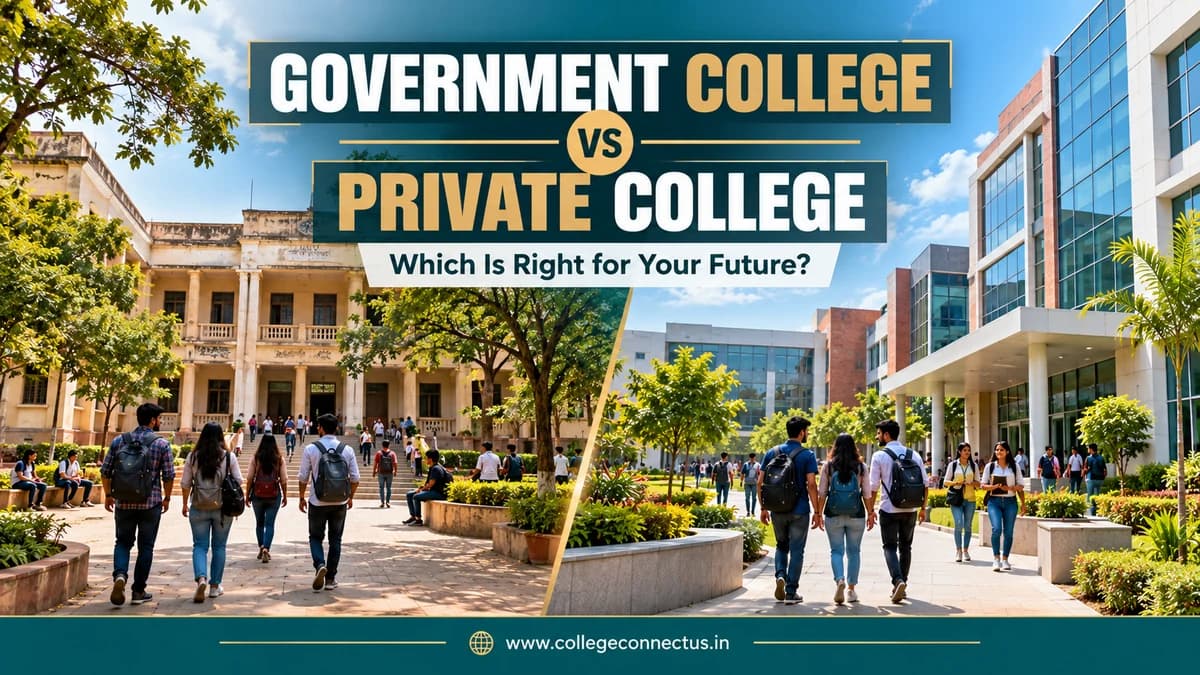
Choosing between a government college and a private college is an important decision for students planning their higher education in India. Both types of institutions can offer valuable academic experiences, but their fees, admission procedures, facilities and career outcomes may differ significantly.
A government college is generally established or managed by a central or state government, while a private college is established or managed by a private organization, trust, society or other eligible sponsoring body. Some institutions also operate under different funding and governance arrangements, so it is important to verify the status of the particular college.
The right choice is not simply about whether a college is government or private. Students should compare the specific course, total cost, recognition, faculty, facilities, placement information and opportunities available at each institution.
In this guide, we explain the key differences between government and private colleges in India and how to evaluate them before applying for admission.
A government college is an institution established, funded or managed by a government authority, such as the central government or a state government. Government institutions may receive public funding and may charge regulated or subsidized fees, depending on the institution, course and applicable policies.
Government colleges offer a wide range of programs, including arts, science, commerce, engineering, medicine, management, law and other professional courses.
However, their admission rules, infrastructure, faculty resources and fees are not identical. A centrally funded institution, a state government college and a government medical college may operate under different systems.
Before applying, students should check the institution's official website, admission brochure, fee schedule and applicable recognition or approval details.
A private college is generally established or managed by a non-government organization, trust, society or other eligible private body. Private colleges operate across many fields, including engineering, management, medicine, law, commerce, science and humanities.
Some private institutions are affiliated with a university, while others operate as constituent colleges or are part of private universities. Their legal status and degree-awarding arrangements can therefore differ.
Private colleges may offer specialized programs, industry-oriented activities, modern facilities or additional student services. The availability and quality of these features vary by institution and should be verified rather than assumed.
Students should check the institution's recognition, university affiliation, relevant course approvals, fee structure and admission requirements before paying an application or admission fee.
The following table explains common differences. These are general patterns, not guarantees about every institution.
Factor | Government College | Private College |
|---|---|---|
Management | Managed by a government authority or public institution | Managed by a private organization or institution |
Fees | May be subsidized or relatively affordable, depending on the course and college | Can vary widely; some programs have higher fees, while others may be competitively priced |
Admission | May use entrance exams, merit lists, counselling or other notified criteria | May use entrance exams, merit, counselling or institution-specific criteria where permitted |
Scholarships | May offer government schemes, fee concessions and institution-based support | May offer government scholarships, institutional scholarships, fee waivers or financial aid |
Infrastructure | Varies by institution, department and available resources | Varies by institution, department and investment |
Faculty | Depends on qualifications, recruitment, staffing and department-level resources | Depends on qualifications, recruitment, staffing and department-level resources |
Placements | Depend on the course, employer demand, student preparation and placement support | Depend on the course, employer demand, student preparation and placement support |
Industry exposure | May include internships, research, projects and industry collaboration | May include internships, industry projects, career services and industry collaboration |
Campus life | Depends on the campus, location, facilities and student activities | Depends on the campus, location, facilities and student activities |
Important: Compare actual colleges and specific courses rather than relying only on the ownership category.
Fees are often a major factor when students compare government and private colleges. Some government institutions receive public funding that can make tuition more affordable, but the exact amount depends on the institution, program, student category and applicable rules.
Private college fees can differ considerably across institutions and courses. A private college may charge more for a particular program, but students should examine the complete fee schedule before drawing conclusions.
Do not compare tuition fees alone. Calculate the total cost of studying, including:
Tuition and admission fees
Examination, laboratory and other academic charges
Hostel accommodation and mess fees
Transport and daily living expenses
Books, equipment, software and study materials
Internship, project or other compulsory program expenses, where applicable
Also check whether fees may change during the program and whether the institution publishes a refund policy.
For example, a college with lower tuition may require substantial travel or accommodation expenses. Another college may charge higher tuition but provide hostel facilities or other services included in its published fees.
Prepare a complete cost estimate for the entire course duration. Use current official fee documents instead of relying on old figures or third-party estimates.
Government and private colleges can both use merit-based admissions, entrance examinations, counselling or other selection procedures. The process depends on the course, institution, state and applicable regulations.
For example, engineering admissions may involve JEE Main, a state-level entrance examination, institutional selection or counselling, depending on the college and admission route. Medical admissions follow the applicable national and regulatory framework, including NEET requirements for relevant undergraduate medical programs.
Private colleges do not all follow one common admission process, and government colleges do not all use the same selection method.
Before applying, confirm:
The required academic qualifications and minimum marks.
The accepted entrance examination, if applicable.
The official application and counselling process.
Reservation, domicile or category requirements, where relevant.
Application deadlines and required documents.
Whether the course and institution meet the applicable regulatory requirements.
Use official admission notices and counselling portals for the year in which you plan to apply.
Recognition and approval are essential checks when comparing colleges. The relevant requirements depend on the type of institution and the course being offered.
Before making a decision, verify:
University status or affiliation: Confirm which university awards the degree and whether the college is affiliated or otherwise authorized to offer the program.
UGC information: Consult the University Grants Commission for relevant information about universities and recognition.
Professional approvals: For regulated programs, check the applicable regulator's official requirements and approved institution or course information. The relevant authority depends on the field.
Accreditation: Check whether the institution or program has accreditation from a recognized accrediting body, where applicable.
Course-specific details: Confirm that the exact campus, program and academic session are covered by the relevant recognition or approval.
A college's marketing material alone is not enough to establish recognition or approval. Verify the details through official sources.
Official reference: University Grants Commission — https://www.ugc.gov.in/
Teaching quality can have a significant influence on a student's learning experience. However, it cannot be judged by the government or private label alone.
Look for information about faculty qualifications, department staffing, laboratory access, class sizes, academic schedules and student support. If possible, review the curriculum, practical work, research opportunities and availability of academic mentoring.
Students can also speak with current students or alumni to understand how classes are conducted and whether the published academic facilities are available in practice.
For professional courses, check whether the curriculum supports the relevant licensing, professional or industry requirements.
Infrastructure requirements differ by course. An engineering student may need well-equipped laboratories and project facilities, while a medical student should carefully check the applicable clinical training arrangements. Students in design, media or computer science may need specialized studios, equipment or computing resources.
When comparing institutions, evaluate:
Classrooms and subject-specific laboratories
Library resources and digital learning access
Computer facilities and internet availability
Hostel, mess and transport arrangements
Sports, clubs and student societies
Accessibility, safety and student support services
Facilities relevant to the exact course
Do not judge a college only by photographs, buildings or promotional videos. Check whether the facilities are available to students in the program you intend to study.
Placements are important for many students, but headline figures can create an incomplete picture if they are not examined carefully.
Both government and private colleges may offer strong career opportunities, while outcomes can also vary between departments within the same institution. Factors include course quality, employer demand, internships, student skills, alumni networks, location and career-support services.
When reviewing placement information, ask for:
Median salary or package, where published
Average salary, with the calculation method if available
Number of students eligible for placement
Number of students who participated in placement activities
Number of students placed
Course- or department-level placement information
Internship opportunities and career guidance
The reporting year and the definition of a placement
The highest package is not a reliable measure of the typical outcome. A single high offer may not represent most students.
Also distinguish between cost to company (CTC) and take-home pay. CTC may include variable pay, employer contributions, bonuses or benefits that are not received as monthly salary.
If a college publishes placement statistics, check whether the figures are independently documented or supported by official reports. Where the information is not available, do not assume that the college has no placements or that its outcomes are strong.
The cost of a course depends on more than its listed tuition fee. Scholarships, fee concessions and financial aid may affect the amount a student actually pays.
Government and private institutions may offer different forms of assistance. Eligibility can depend on academic performance, household income, social category, disability status, state of residence, course and other scheme-specific requirements.
Students should investigate:
Central or state government scholarship schemes
Institution-specific scholarships and fee waivers
Merit-based and need-based financial aid
Hostel or other eligible concessions
Renewal conditions and minimum academic requirements
Application deadlines and required documents
Never assume that a scholarship is guaranteed until eligibility and approval are confirmed. Check whether financial assistance covers tuition only or includes other expenses.
Practical experience can help students develop skills and understand career options. Both government and private colleges may offer internships, live projects, research, industry visits, entrepreneurship programs or professional workshops.
The value of these opportunities depends on their quality and accessibility.
Ask whether internships are compulsory or optional, whether the college helps students find them, and whether projects are integrated into the curriculum. For research-oriented courses, investigate the availability of faculty-led projects and research facilities.
A college's claimed industry partnerships should be evaluated by looking for evidence of actual student opportunities rather than relying on partner logos alone.
The location of a college can influence living costs, travel time, internship access and overall student experience.
Consider whether you would prefer to study near home or relocate to another city. Compare transport options, hostel availability, food expenses, local safety information and access to healthcare or other essential services.
Student life also matters. Clubs, cultural events, sports, peer groups and mentoring can help students build confidence and relationships.
These experiences vary by campus and student participation. Speak with current students if possible, and assess whether the campus environment suits your learning style and personal needs.
No. The government or private status of an institution does not, by itself, determine its academic quality or career outcomes.
A government college may be attractive because of its fee structure, academic reputation, location or course offerings. A private college may be worth considering because of a particular specialization, available facilities, industry-linked learning or the admission options it offers.
However, these advantages must be verified for the individual institution and program. A lower fee does not automatically mean a better educational experience, and a higher fee does not guarantee better placements.
The most useful comparison considers verified evidence, the total cost of attendance, course suitability and the student's own goals.
Use the following checklist before shortlisting institutions.
Decide what you want to study, such as engineering, medicine, management, law, science, commerce or humanities. Different courses require different facilities and admission checks.
Select several government and private institutions that offer the course you want. Compare colleges at the course and campus level rather than making a decision based on category alone.
Review official university, regulator and admission information. Confirm that you meet the eligibility criteria and understand the admission process.
Compare tuition, accommodation, transport, food, academic materials and other applicable charges. Then investigate scholarships and financial aid for which you may qualify.
Check the curriculum, faculty information, laboratories, internships, placement reports and student support. Look for course-specific data and reporting dates.
Consider location, accommodation, travel, accessibility, student activities and the support available to students.
Give each factor a score based on your priorities. For example, if affordability is essential, give total cost greater weight. If practical training is your priority, focus on course-specific facilities and internship opportunities.
Choose the institution that best meets your needs and budget using verified information, rather than relying on a single ranking, advertisement or placement headline.
Avoid these mistakes when comparing government and private colleges:
Assuming every government college is better than every private college.
Assuming higher fees guarantee better teaching or placements.
Comparing the highest salary package instead of typical outcomes.
Ignoring hostel, transport and other living expenses.
Relying on outdated fees or placement statistics.
Choosing a college without checking recognition, affiliation or course approvals.
Treating rankings as the only measure of academic quality.
Assuming scholarships or placements are guaranteed.
Paying fees before reading the official admission and refund policies.
A careful comparison can help you avoid unnecessary expenses and choose a program that fits your goals.
The main difference is their ownership, management and funding structure. Government colleges are managed by public authorities or institutions, while private colleges are generally managed by private organizations. Fees, admission rules, facilities and career outcomes vary by institution.
Some government colleges charge subsidized or relatively low tuition fees, but this is not universal. Private college fees also vary widely. Compare the complete cost of the specific course, including accommodation and other charges, before deciding.
Not necessarily. Placement outcomes depend on the institution, course, employer demand, student skills and other factors. Compare course-specific placement data, median packages where available, placement rates and the reporting year instead of relying only on the college's highest package.
Yes, eligible students may be able to access government scholarships or institution-specific financial assistance at private colleges. Availability and eligibility depend on the scheme, course, institution and applicable rules. Always verify the current conditions.
Start with the relevant official university or regulator website. Verify the institution's status, degree-awarding arrangement, affiliation and any course-specific approvals required for your program.
There is no universal answer. Compare the course curriculum, recognition, total cost, faculty, facilities, career options and your long-term interests. Make sure you are comparing valid admission options and the same or closely related academic programs.
Confirm the course and institution's recognition, eligibility requirements, admission process, complete fee structure, refund policy, scholarships, campus facilities and available placement evidence. Keep copies of official notices and payment receipts.
The choice between a government college and a private college in India should be based on the quality and suitability of the specific institution, not just its category.
Compare fees, recognition, academic resources, course-specific placement information, internships, scholarships and the overall student experience. Use official documents wherever possible, and consider the total cost over the entire duration of the course.
On College Connect Us, students can use a structured college-comparison process to explore their options and prepare more informed questions before applying. Always verify current admissions, fees and approvals through the relevant official sources before making your final decision.
Make your college decision with facts, not assumptions.
Explore expert articles, admission guides, career tips, education news, exam preparation, and everything you need to make informed academic decisions.