
College Connect
Preparing your experience...
Preparing your experience...

Need help? 👋
We're here to help you
Looking for the right college, course or admission guidance? Choose an option below.
A practical guide to cancelling college admission in India, including the withdrawal procedure, refund-policy checks, required documents, application format, common mistakes, and steps for tracking a refund.
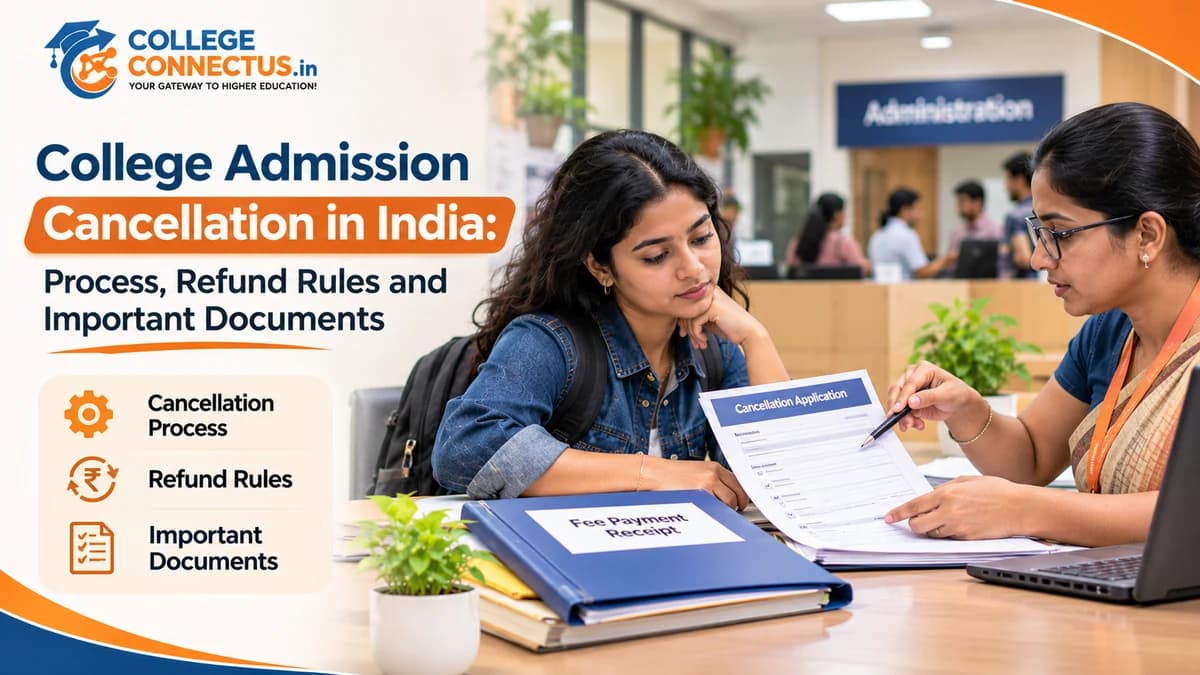
Choosing a college is an important decision, but sometimes students need to change their plans after accepting admission. They may receive an offer from another institution, reconsider their course choice, face financial difficulties, or discover that the programme does not match their expectations.
In such situations, understanding the college admission cancellation process in India can help students make an informed decision and complete the required formalities.
However, cancelling admission is not always as simple as informing the college that you no longer wish to join. Depending on the institution and admission process, you may need to submit a formal withdrawal request, complete an online procedure, return institutional documents, or follow specific instructions issued by a counselling authority.
Fee refunds can also depend on the applicable rules, the date of withdrawal, the type of fee paid, and the circumstances of admission.
This guide explains how to cancel college admission in India, what documents may be required, how to understand refund policies, and how to avoid common mistakes.
College admission cancellation refers to formally withdrawing from an admission that you have accepted or completed.
The process may involve cancelling a provisional offer, withdrawing from a counselling-allotted seat, or leaving a college after completing admission formalities.
The correct procedure depends on your admission stage.
For example:
Before accepting an offer: You may only need to decline the offer through the prescribed process.
After accepting an offer but before joining: You may need to submit a withdrawal request and follow the stated refund procedure.
After paying admission fees: You may need to complete formal cancellation steps before any eligible refund is processed.
After completing enrolment: The institution may require a formal withdrawal application and additional clearance.
During centralised counselling: You may need to follow the counselling authority's rules in addition to the college's procedures.
These situations are not interchangeable. Before taking action, identify which institution or authority controls your admission and which rules apply to your case.
Students may consider cancelling admission for several reasons.
A student may receive an offer from another institution that better matches their course preferences, location requirements, academic goals, or budget.
Before withdrawing from the existing seat, check the acceptance deadline and withdrawal rules for both institutions.
After reviewing the curriculum, students may realise that their selected course does not match their interests or career plans.
If you are reconsidering your programme, read How to Choose the Right College Course After Class 12: Career Scope, Fees and Eligibility before making a final decision.
The total cost of attending a college may be higher than initially expected because of accommodation, transportation, food, equipment, or other expenses.
Before cancelling, request the complete fee structure and check whether any financial assistance or suitable alternative is available.
You can also refer to How to Compare College Fees and Placement Packages to understand why tuition fees alone may not reflect the full cost of studying.
Health-related needs, family responsibilities, relocation, or other personal circumstances may affect a student's ability to attend college.
If you cannot continue with the admission, contact the official admission office to understand the available options and required procedure.
A student may discover that a course has additional eligibility requirements or that a necessary document cannot be provided within the required period.
In this situation, seek clarification from the college or counselling authority before deciding whether to withdraw.
Although procedures differ between institutions, the following steps provide a practical starting point.
Before submitting a cancellation request, review the admission offer, admission brochure, fee policy, and applicable withdrawal instructions.
Look for information about:
The permitted method of cancellation
The deadline for submitting a withdrawal request
Refund eligibility
Fees that may be non-refundable
Any applicable deductions
Documents required for cancellation
The expected process for returning original documents
The official channel for submitting a complaint or appeal
If you were admitted through a centralised counselling process, check the relevant counselling rules as well.
Do not assume that a policy from another college applies to your institution.
Identify whether your admission is managed directly by the college, a university, or a centralised counselling authority.
Some institutions use an online student portal for withdrawal requests. Others require an application to the admission office or registrar.
In certain admission processes, a student may need to complete both a counselling-portal action and a college-level formal procedure.
Ask the relevant authority to confirm the exact steps for your admission category and current stage.
If you have already paid fees, find out which amounts may be refundable under the applicable policy.
Separate the amounts into categories such as:
Tuition fees
Admission or registration fees
Seat-acceptance fees
Security deposits
Hostel deposits
Hostel or mess charges
Other institutional charges
Do not assume that all these payments are treated identically.
Ask the institution to explain how the refund will be calculated and whether different deadlines apply to different components.
Important: There is no single refund amount or deadline that can safely be assumed for every college in India. The applicable policy, relevant regulations, timing, and nature of the payment must be checked for your particular admission.
Collect the documents specified by the college or counselling authority.
Depending on your circumstances, you may need:
Admission offer letter or allotment letter
Admission confirmation or enrolment document
Fee-payment receipts
Student application or registration number
Identity document, where required
Signed admission cancellation application
Bank account details for an eligible refund
Any refund request form prescribed by the institution
Original-document return request, where applicable
Other documents specifically requested by the college
Do not send sensitive documents to unverified email addresses or unofficial contacts.
If the college asks for bank details, use the official submission method and confirm which account-holder information is required.
Follow the institution's prescribed method.
This may involve an online portal, a written application, an official email, or a designated administrative office.
Your request should clearly state:
Your full name
Your application or enrolment number
The course and academic session
The date admission was granted
The date and amount of fees paid, where relevant
Your request to withdraw from admission
Your request for a refund, if applicable
Your request for confirmation and further instructions
Keep a copy of the submitted application and any acknowledgement.
If you submit the request in person, ask for a dated acknowledgement. If you submit it electronically, retain the email, portal confirmation, or ticket number.
After submitting your cancellation request, ask the college or relevant authority to confirm that it has received and processed the request.
If the request is pending, ask whether additional documents or actions are required.
Keep the following information for your records:
Cancellation request reference number
Submission date
Name or department of the receiving office
Current status of the request
Any outstanding requirements
Expected next steps, as communicated by the institution
Do not assume that an application has been processed simply because you sent an email or handed over a form.
If the institution holds any original documents, ask for written instructions on how to retrieve them.
Clarify:
Which documents are held by the institution
Whether you must visit the campus
Whether an authorised representative may collect them
What identification or authorisation is required
Whether a collection appointment is necessary
How the institution will acknowledge the return
Make a list of the documents returned to you and retain the acknowledgement.
The applicable rules may restrict how institutions handle original documents, so check the relevant requirements if there is a dispute.
If a refund is due, ask the institution for the status of your request.
Confirm:
Whether the cancellation has been approved
Which fee components are eligible for a refund
Whether any deduction has been applied
Whether additional information is needed
Whether the refund has been authorised
How you will be notified when payment is processed
Keep the original fee receipts and cancellation acknowledgement until the matter is fully resolved.
If the refund does not arrive within the timeframe communicated by the institution, follow up in writing and request a status update.
Refund eligibility is often one of the biggest concerns when students cancel admission.
The amount that may be refunded depends on the applicable rules and the details of the payment.
Start with the institution's official refund policy and the rules governing your admission process.
Depending on the college and course, relevant requirements may come from the institution, university, counselling authority, or applicable regulator.
If the admission is governed by a specific regulatory or counselling framework, check its current instructions rather than relying on an old notice or an informal online explanation.
Some policies distinguish between different withdrawal periods.
The date on which you submit the cancellation request may be important, so retain proof of the submission date.
If a portal action and a written application are both required, clarify which date the institution uses when determining refund eligibility.
The fee receipt may include several different charges.
Ask the institution to provide an itemised explanation of any proposed refund or deduction.
For example, a security deposit may be treated differently from an admission fee or a charge for services already provided.
Do not assume that a fee is refundable or non-refundable simply because it has a familiar name.
If the college offers a partial refund, request a written breakdown showing:
Total amount paid
Each fee component
Amount considered refundable
Any deductions
Final refund amount
Status of the refund request
This makes it easier to identify a discrepancy and ask a specific question if the calculation appears inconsistent with the published policy.
If the stated processing period has passed, contact the accounts department or admission office through the official channel.
Provide your application number, payment receipt, cancellation acknowledgement, and refund reference, if available.
Ask for a written status update and a clear explanation of any pending requirement.
If the institution does not resolve the issue, review the applicable grievance process and consider approaching the relevant university, counselling authority, regulator, or consumer-dispute channel where appropriate.
The correct escalation route depends on the nature of the institution and the issue.
If your institution accepts a written request, the following sample can help you prepare one. Adapt it to the college's prescribed form and instructions.
Subject: Request for Cancellation of College Admission and Refund of Eligible Fees
To,
The Admission Officer / Registrar
[College or University Name]
[College Address]
Respected Sir/Madam,
I am writing to request the cancellation of my admission to [Course Name] for the [Academic Session] academic year.
My admission details are as follows:
Student Name: [Full Name]
Application or Enrolment Number: [Number]
Course: [Course Name]
Academic Session: [Year]
Date of Admission: [Date]
Fees Paid: [Amount, if applicable]
Due to [brief reason, if you wish to provide it], I am unable to proceed with the admission.
I request you to guide me through the required cancellation formalities and process any eligible fee refund in accordance with the applicable rules and institutional policy.
Please confirm receipt of this request and inform me if any additional documents or steps are required. If the institution holds any original documents belonging to me, kindly provide instructions for their return.
Thank you for your assistance.
Yours faithfully,
[Full Name]
[Contact Details]
[Date]
Before submitting: Replace the placeholders, confirm the correct recipient, and use the college's official cancellation form if one is mandatory. Do not include unnecessary sensitive information.
If you believe that a refund has been withheld incorrectly or is taking longer than the applicable policy permits, follow a documented process.
Read the policy that applied to your admission and withdrawal date. Check whether the institution has explained its decision or calculated the refund correctly.
Write to the admission office or accounts department with your application number, fee receipts, cancellation acknowledgement, and a concise description of the issue.
Ask for a written explanation and the status of your refund.
If the matter remains unresolved, check whether the college, university, or counselling authority has a formal grievance mechanism.
Use the appropriate route for the institution and programme. Keep copies of all correspondence and responses.
Where appropriate, review the relevant regulator's rules or seek qualified advice about the options available to you.
Do not assume that one complaint mechanism or refund rule applies to every institution.
Students may focus on leaving the college without checking how withdrawal affects their fees or counselling options.
Better approach: Review the applicable cancellation and refund rules first.
Different fee components may be treated differently.
Better approach: Request an itemised explanation of the refund policy and calculation.
A verbal conversation may not provide sufficient evidence of when you submitted your request or what the institution agreed to do.
Better approach: Submit the request through the official channel and retain written acknowledgement.
Withdrawing from a seat may affect your participation in later rounds or your eligibility for another option, depending on the rules.
Better approach: Confirm the consequences with the relevant counselling authority before acting.
Students may complete cancellation without arranging the return of documents held by the institution.
Better approach: Ask for written instructions and keep an acknowledgement of returned documents.
An unverified person may claim they can guarantee a refund or cancel admission for a fee.
Better approach: Deal directly with the official college or counselling authority unless a verified, authorised representative is genuinely required.
Fee receipts and cancellation emails may be needed if a dispute arises later.
Better approach: Keep the relevant records until cancellation and any refund issues are resolved.
Before completing your withdrawal, review this checklist.
I have identified the authority responsible for my admission.
I have read the applicable cancellation and refund policy.
I understand how withdrawal may affect other admission options.
I have checked the deadline and submission procedure.
I have collected the required documents.
I have prepared the cancellation request.
I have retained proof of submission.
I have requested confirmation of cancellation.
I have asked about the return of original documents, if applicable.
I have requested an itemised refund calculation, where relevant.
I have recorded the refund reference and follow-up details.
I know the official grievance route if the issue remains unresolved.
Check the institution's cancellation policy, identify the required procedure, prepare the necessary documents, and submit a formal withdrawal request through the official channel. If your admission is managed through centralised counselling, follow the relevant counselling instructions as well.
You may be eligible for a full or partial refund, depending on the applicable policy, timing, type of fee, and relevant rules. Check the official policy and request an itemised explanation before assuming a particular amount will be refunded.
There is no single deadline that should be assumed to apply to every institution and admission process. Check the relevant college, university, counselling authority, or regulatory instructions for your case.
Commonly requested documents may include an admission or allotment letter, application number, fee receipts, a cancellation application, and prescribed refund forms. The exact requirements vary, so follow the institution's official checklist.
You can request withdrawal after payment, but the procedure and refund eligibility depend on the applicable rules. Review the policy and submit your request through the official channel.
Keep proof of your submission and follow up with the admission office or registrar. If the request remains unresolved, use the institution's official grievance process or the relevant authority's procedure.
State your name, application number, course, academic session, request for withdrawal, and refund request where applicable. Use the institution's prescribed form if one exists, and retain a copy of the submitted application.
This may be possible, but you should check the withdrawal rules of your current institution and the acceptance deadlines and conditions of the new institution. If centralised counselling is involved, confirm how the change affects your seat and participation in further rounds.
Ask the institution for the official procedure to retrieve them. Request written confirmation of the collection requirements and retain an acknowledgement when the documents are returned.
Check the published refund policy and the status communicated by the institution. Follow up in writing with your payment receipt and cancellation acknowledgement. If the matter remains unresolved, consider the relevant grievance process or seek appropriate advice.
Cancelling college admission requires more than submitting a simple request. Students should understand the applicable rules, document the withdrawal, check refund eligibility, and confirm that all required formalities have been completed.
Before acting, verify the cancellation procedure with the institution or counselling authority responsible for your admission. Keep copies of your applications, fee receipts, and official communications until the matter is resolved.
A clear, documented process can help you manage admission withdrawal more confidently and reduce avoidable confusion.
Explore expert articles, admission guides, career tips, education news, exam preparation, and everything you need to make informed academic decisions.