
College Connect
Preparing your experience...
Preparing your experience...

Need help? 👋
We're here to help you
Looking for the right college, course or admission guidance? Choose an option below.
This guide compares BCA and B.Tech in India, covering eligibility, curriculum, duration, fees, practical learning, specialisations and career opportunities. Learn how to evaluate both degrees according to your academic background, interests, budget and career goals before selecting a college and course.
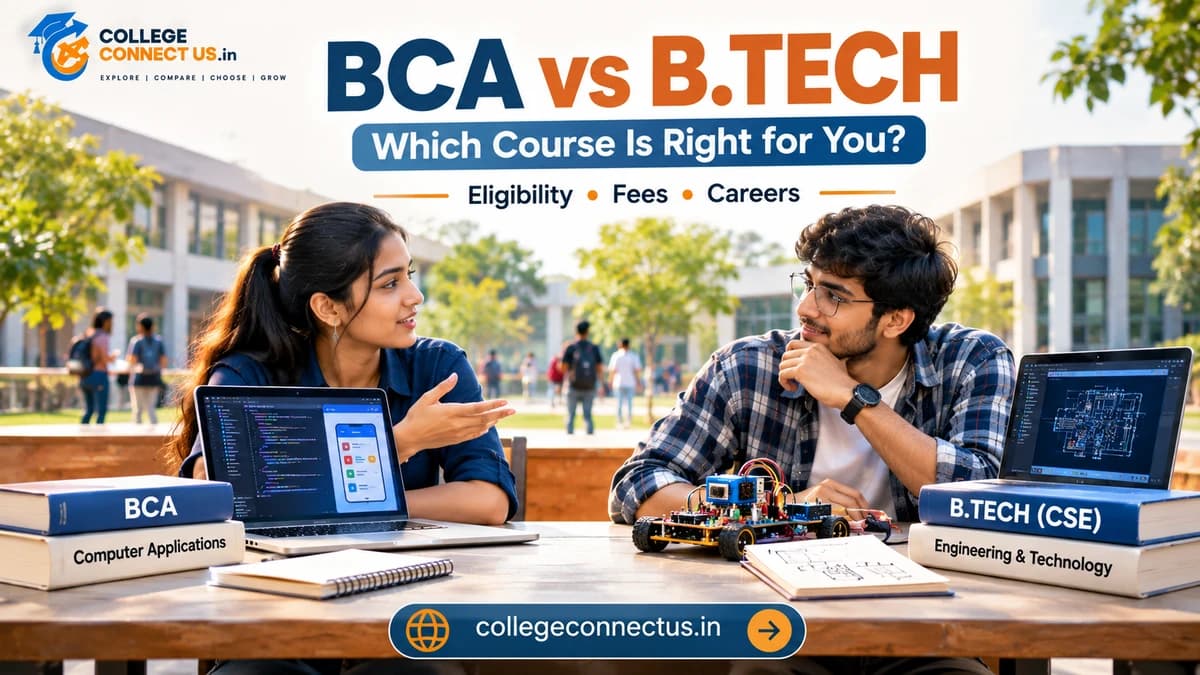
Choosing the right undergraduate degree can influence what you study, which skills you develop and the opportunities you explore after graduation. For students interested in computers and technology, two commonly considered options are Bachelor of Computer Applications (BCA) and Bachelor of Technology (B.Tech).
Although both degrees can lead to technology-related careers, they differ in their academic focus, eligibility requirements, curriculum and learning approach.
BCA generally focuses on computer applications, programming and software-related subjects, while B.Tech is an engineering degree whose curriculum depends on the chosen branch. B.Tech in Computer Science and Engineering, for example, combines computing with engineering-oriented foundations and technical problem-solving.
Neither degree is automatically better for every student. The right choice depends on your academic background, interests, budget, preferred learning experience and future plans.
This guide compares BCA vs B.Tech in India to help you make a more informed decision.
Bachelor of Computer Applications is an undergraduate programme focused on computing, software and computer applications.
The exact curriculum varies by university, but BCA programmes commonly cover topics such as:
Programming fundamentals
Data structures and algorithms
Database management systems
Computer networks
Operating systems
Web development
Software engineering
Application development
Practical laboratory work and projects
Some institutions also offer electives in areas such as cloud computing, cybersecurity, artificial intelligence or data analytics. The availability and depth of these subjects depend on the programme.
BCA may be worth considering if you are interested in:
Learning programming and software development
Building websites or applications
Working with databases and information systems
Exploring IT support or software-related roles
Developing practical computing skills
Pursuing further study in computing or a related field
Review the curriculum of each institution carefully. The degree title alone does not tell you how much practical work, programming or specialisation a particular programme provides.
Bachelor of Technology is an undergraduate engineering degree. Students choose a specific engineering branch, such as Computer Science and Engineering, Information Technology, Mechanical Engineering, Civil Engineering, Electrical Engineering or Electronics and Communication Engineering.
For a student comparing BCA with B.Tech, the most direct comparison is often BCA versus B.Tech in Computer Science and Engineering (CSE), although the two programmes are not identical.
A B.Tech CSE curriculum commonly includes:
Programming and computational thinking
Data structures and algorithms
Computer architecture
Operating systems
Database systems
Computer networks
Software engineering
Mathematics and engineering foundations
Laboratory work and technical projects
The balance of theory, mathematics, engineering fundamentals and practical work varies by institution.
B.Tech CSE may be worth considering if you want to:
Study computing alongside engineering foundations
Explore computer science concepts in greater depth
Develop software and systems engineering skills
Work on technical projects and laboratory assignments
Consider engineering-oriented postgraduate study
Keep options open across several computing specialisations
B.Tech in other branches follows a different curriculum. A student interested in mechanical or civil engineering, for example, should compare those branches with their own interests rather than assuming that all B.Tech degrees focus on software.
The following table provides a general comparison. Actual programme structures, eligibility requirements and costs vary by institution.
Factor | BCA | B.Tech |
|---|---|---|
Full form | Bachelor of Computer Applications | Bachelor of Technology |
Degree focus | Computer applications and computing | Engineering in a chosen branch |
Typical duration | Often 3 years; some institutions offer different structures | Commonly 4 years |
Academic emphasis | Programming, applications, software and IT | Engineering foundations and branch-specific technical subjects |
Mathematics | Depends on the institution and programme | Mathematics is commonly important, especially in engineering programmes |
Admission requirements | Vary by institution; some accept different Class 12 subject combinations | Engineering programmes commonly require specified subjects, often including Physics and Mathematics |
Entrance examinations | Depends on the institution | May include national, state or institution-level engineering entrance examinations |
Practical learning | Programming labs, application projects and assignments | Engineering labs, technical projects and branch-specific practical work |
Fees | Depend on institution, location and facilities | Depend on institution, branch, location and facilities |
Potential career directions | Software, applications, databases and IT-related roles | Engineering roles and, for CSE, software and computing-related roles |
Further study | May include MCA or other eligible postgraduate programmes | May include M.Tech or other eligible postgraduate programmes |
Best comparison approach | Review the specific BCA curriculum and outcomes | Compare the chosen engineering branch and its curriculum |
Important: The table describes common patterns, not universal rules. Check the official eligibility criteria and programme structure of each college before applying.
Eligibility is one of the most important factors to check before comparing colleges.
BCA admission requirements vary across universities and colleges.
Depending on the institution, applicants may need:
Completion of Class 12 or an equivalent qualification
A minimum percentage or qualifying grade
Mathematics or another specified subject, where required
A qualifying entrance examination or institutional selection process, where applicable
Some institutions accept students from multiple academic streams, while others specify subject requirements.
Do not assume that every BCA programme has the same eligibility criteria.
Engineering admission usually involves more specific subject requirements.
For many B.Tech programmes, applicants need to have studied Physics and Mathematics, along with any additional subjects and conditions specified by the institution or applicable admission rules.
Depending on the programme, applicants may also need to meet:
Minimum qualifying marks
Entrance examination requirements
Subject-specific eligibility conditions
Counselling and seat-allocation rules
Category-specific or other applicable admission provisions
Requirements can differ by institution, state and admission route.
For a more detailed explanation, read our existing guide on college eligibility criteria in India.
There is no universal answer. A student may meet the eligibility criteria for a particular BCA programme but not a particular B.Tech programme, or may qualify for both.
Your decision should begin with the programmes for which you are eligible, followed by curriculum, cost and career considerations.
Course duration affects both the time and the total cost required to complete a degree.
BCA programmes commonly run for three years, although some institutions offer different programme structures. B.Tech programmes commonly run for four years.
Always verify the actual duration and structure listed by the institution.
A BCA student may spend substantial time learning programming, working with databases, developing applications and completing computing projects.
The depth of mathematics, theory and specialised computing topics depends on the institution's curriculum.
A B.Tech CSE student typically studies programming and computing alongside engineering and mathematical foundations.
The programme may include more extensive engineering laboratory work, systems-level topics and branch-specific technical subjects.
Compare the actual semester-wise syllabus rather than relying only on course descriptions.
Ask these questions:
Which programming languages and computing concepts are taught?
How much time is allocated to practical work?
Are students required to complete individual or team projects?
Are internships encouraged or included?
Does the curriculum cover subjects relevant to your interests?
Are electives available in areas you may want to explore?
How frequently is the syllabus reviewed or updated?
A well-matched curriculum can help you stay engaged and develop skills that are useful for your intended direction.
There is no reliable universal fee comparison between BCA and B.Tech because costs vary considerably by college, location, facilities and programme.
BCA may cost less at some institutions, but that does not mean every BCA programme is cheaper than every B.Tech programme.
Before deciding, calculate the total expected cost.
Include:
Tuition fees
Admission and examination charges
Laboratory or technology fees
Hostel or rented accommodation
Food and daily living expenses
Travel
Books, equipment and a computer, if needed
Internship-related or project expenses
Any additional charges specified by the institution
Compare the total cost for the full duration of the programme, not just the first-year tuition fee.
Also investigate eligible scholarships and financial assistance. Check the conditions, renewal requirements and deadlines rather than assuming that funding will be available.
For a more detailed approach, read how to compare college fees and placement packages.
BCA graduates may pursue entry-level roles related to software, applications, IT operations and computing, depending on their skills and the employer's requirements.
Potential directions include:
This path may suit graduates who have developed programming skills and can demonstrate their ability through projects or practical assessments.
Web development roles may involve building and maintaining websites and applications. Relevant skills can include HTML, CSS, JavaScript, backend development and databases, depending on the position.
Testing roles may involve checking software behaviour, documenting defects and helping teams improve product quality. Technical requirements vary between manual and automation testing positions.
Support roles can involve troubleshooting, documenting issues, assisting users and maintaining business applications.
Some graduates may pursue junior roles involving database operations, SQL, reporting or data management when they have the necessary skills.
Depending on admission requirements, BCA graduates may consider an MCA or other postgraduate programmes in computing and related disciplines.
Before enrolling in further study, compare eligibility, fees, curriculum and the purpose of the qualification.
B.Tech CSE graduates can explore several computing-related directions, depending on their skills, projects, experience and employer requirements.
Potential directions include:
Software development
Web or application development
Quality assurance and software testing
Systems or IT engineering
Database and backend development
Network-related roles
Cloud or infrastructure roles
Data-related positions, where the required skills are demonstrated
Some specialised roles require additional knowledge, experience or qualifications. A degree alone does not guarantee eligibility for every position.
B.Tech graduates from other branches may pursue careers related to their engineering specialisation.
Some may later move into software or other technology-related roles by developing relevant skills, but the transition depends on the employer, the position and the candidate's preparation.
Choose a branch based on the subject matter you want to study, not solely on the assumption that all branches lead to the same careers.
Neither degree guarantees better placement outcomes.
Placement opportunities depend on the specific college, course structure, employer participation, student preparation, location and job market.
When comparing colleges, investigate the following:
Number of eligible students and number placed
Placement percentage and how it is calculated
Median salary, where reliable data is available
Roles offered to graduates
Recruiters relevant to your chosen field
Internship opportunities
Whether figures cover the entire institution or a specific programme
Whether reported data is current and verifiable
Be cautious about comparing the highest salary from one college with the average or median salary from another. These figures measure different things.
Also check whether placement reports distinguish between BCA, B.Tech CSE and other programmes. Institution-wide results may not accurately represent the outcomes of your particular course.
Our guide on how to evaluate college placements in India explains the factors to examine before making a decision.
Both degrees can provide a route into software development, but the programmes offer different educational experiences.
BCA may be suitable if you want to focus on computer applications, programming and software projects.
B.Tech CSE may suit students who also want to study engineering foundations, mathematics, systems and broader computer science concepts.
For either degree, employers may assess practical skills, problem-solving ability, projects, communication and performance in technical interviews.
To compare the programmes effectively:
Review the programming and computer science subjects.
Check the amount of practical laboratory work.
Examine the project requirements.
Identify internship and placement opportunities.
Review the skills expected for entry-level positions.
Consider whether further study may be useful for your goals.
Do not choose solely on the basis of assumptions about which degree employers prefer. Look at the requirements of the roles and employers you want to pursue.
Use the following steps to make a structured decision.
Confirm which programmes you can apply for based on your Class 12 subjects, marks and any entrance examination requirements.
Ask whether you prefer a computing-focused programme or an engineering degree with broader technical foundations.
If you are considering B.Tech, compare individual branches rather than treating all engineering programmes as interchangeable.
Read the syllabus for the specific colleges on your shortlist. Compare programming, mathematics, practical work, electives and project opportunities.
Estimate tuition and living expenses for the entire programme. Consider scholarships only after verifying eligibility and conditions.
Evaluate course quality, facilities, practical learning, recognition, student support and programme-specific placement information.
Look at relevant job descriptions and identify the qualifications and skills they require. Consider how each degree could help you develop those skills.
Choose a few suitable programmes based on eligibility, cost, curriculum and your preferences. Keep alternatives in case admission outcomes differ from expectations.
If you are still comparing institutions, our guide on how to compare colleges before taking admission in India provides a broader comparison framework.
A high salary reported by one graduate does not represent the likely outcome for every student. Compare reliable programme-level data and the skills required for relevant roles.
The degrees have different structures and purposes. The more suitable choice depends on your eligibility, interests, financial circumstances and preferred learning experience.
A shorter programme may reduce the time required for graduation, but you should also consider the curriculum, practical learning and opportunities available at the specific institution.
The course name is only one part of the decision. Teaching quality, laboratories, projects, support services and programme-specific outcomes also matter.
Requirements can vary. Check the actual programme and admission route before applying.
Extra training can be useful when it addresses a specific skill gap. Choose learning activities based on your goals instead of collecting certificates without a plan.
Neither degree is universally better. BCA focuses on computer applications and computing, while B.Tech is an engineering degree with a branch-specific curriculum. Compare the programmes against your interests, eligibility, costs and career goals.
Yes, BCA graduates may pursue software development roles if they develop the skills required by employers. Programming knowledge, practical projects, problem-solving and interview preparation can be important, depending on the position.
Not at every institution. Subject requirements vary by college and programme. Check the official eligibility criteria for the BCA course you intend to apply for.
Engineering programmes commonly have specific subject requirements, often including Physics and Mathematics. Confirm the applicable eligibility rules for the particular institution and admission route.
Some BCA graduates are eligible to apply for MCA programmes, but admission conditions vary. Check the requirements of the specific university, including any subject, marks or entrance examination conditions.
It depends on the institution. Compare total programme costs, including tuition, accommodation, travel and other charges, rather than assuming one degree is always cheaper.
Both degrees can lead to technology-related opportunities, depending on the role and your preparation. Employers may assess qualifications, skills, projects, experience and interview performance.
Choosing between BCA and B.Tech requires more than comparing degree names. Examine the eligibility requirements, curriculum, total cost, practical learning opportunities and career paths associated with the specific programmes you are considering.
BCA may appeal to students who want a computing-focused undergraduate degree. B.Tech CSE may appeal to students who want to study computing alongside engineering foundations. Both routes require effort to build practical skills and prepare for relevant opportunities.
Before deciding, compare actual colleges and courses, verify admission requirements and select the programme that best fits your circumstances and goals.
Explore more course and college resources on College Connect Us.
Explore expert articles, admission guides, career tips, education news, exam preparation, and everything you need to make informed academic decisions.